Search Episodes
Search for podcast episodes by title, guest, or topic.
Search for podcast episodes by title, guest, or topic.
Search for podcast episodes by title, guest, or topic.

Rachit Magon
Josh Kilmer-Purcell and Dr. Brent Ridge bought a weekend farm in upstate New York, then lost their jobs a month apart in the 2008 recession. What they Googled next turned into Beekman 1802, a goat milk skincare brand now doing more than $150 million a year.
In 2006, a physician and an advertising executive drove out of New York City for a weekend of apple picking and came back having bought a 200 year old farmhouse in a town they'd never heard of. Neither of them had farmed a day in their life. Two years later, they'd both lose their jobs within 30 days of each other, and the only thing standing between them and foreclosure was a note from a neighbor asking if they could take in 80 goats.
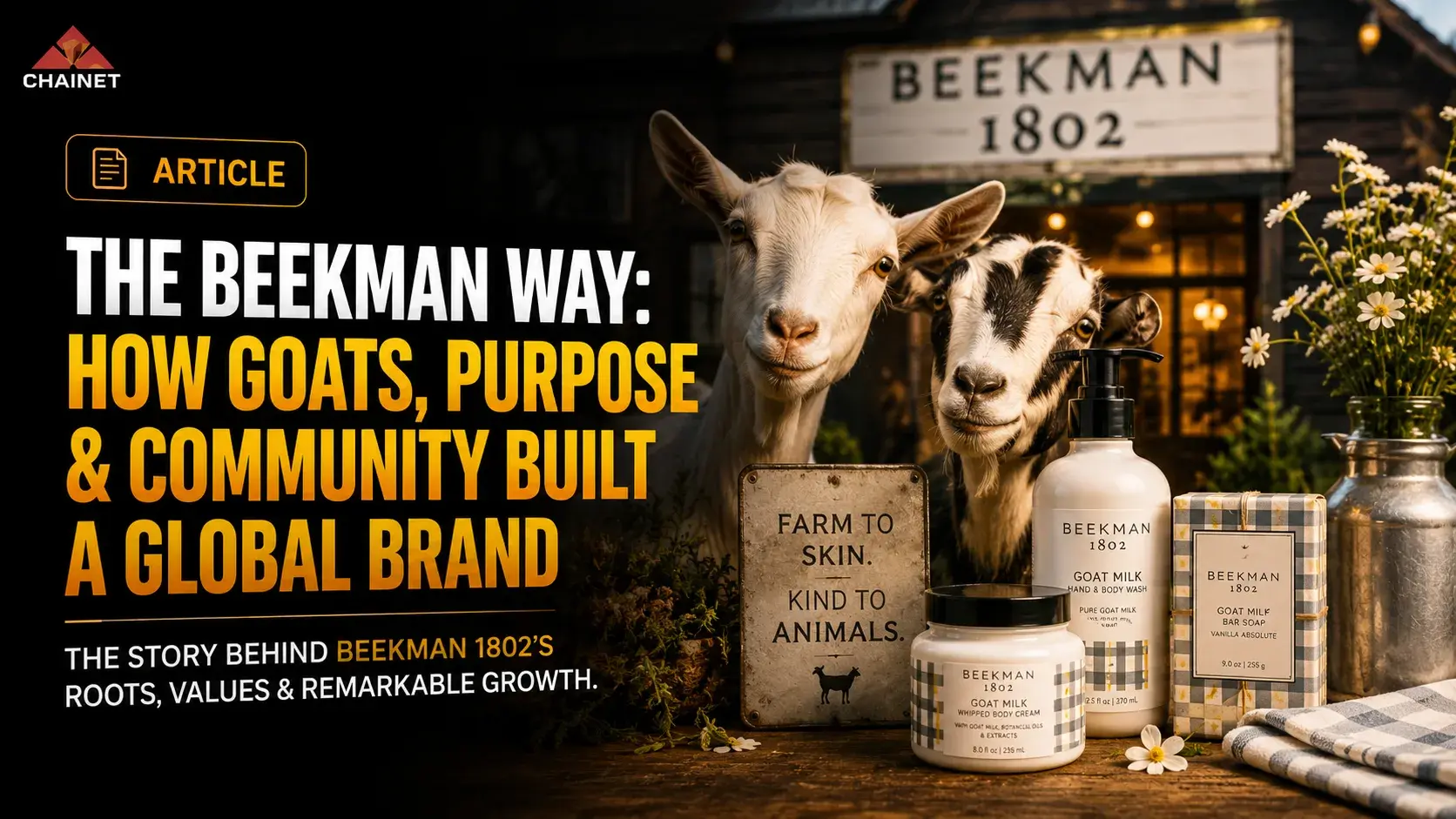
That farmhouse became Beekman 1802. The goats became the reason the brand exists at all. Today, the company Josh Kilmer-Purcell and Dr. Brent Ridge built out of that accident has sold more than 60 million bars of goat milk soap, crossed $150 million in retail sales, and put more than 220 people on payroll across offices in New York and Florida.
None of it was the plan. That's kind of the point.
This is the story of how a soap made at a kitchen table because two guys needed to make an $80-a-day mortgage payment turned into one of the biggest goat milk skincare companies in the world, and what it actually took to get there.
Kilmer-Purcell and Ridge met in New York in 2000. Ridge was a physician who'd go on to launch the health and wellness division at Martha Stewart Omnimedia. Kilmer-Purcell worked in advertising and had already published a couple of memoirs. Neither of them was looking to become a skincare founder.
The farm in Sharon Springs, upstate New York, was meant to be nothing more than a weekend escape from city life. They cashed in savings to buy it. Not long after moving in, a neighboring farmer named John sent word that he was losing his own farm and had nowhere for his 80 goats to go. Would the couple mind if he moved the herd into their empty barn? They said yes, and invited John to live in a cottage on the property as caretaker.
For a while, that was it. A city couple with a historic house, a herd of goats they hadn't asked for, and a farmer running things. Then the 2008 recession hit.
Ridge and Kilmer-Purcell lost their jobs within a month of each other, with a new mortgage on the farm still due every month. There was no backup plan. So they turned to Google.
"So we literally Googled, 'What can we make with goat milk?'" Kilmer-Purcell has said. The first result was goat milk soap.
They started making bars in the kitchen. Kilmer-Purcell taught himself to code so he could build the brand's first website himself, since there wasn't money to pay anyone else to do it. Beekman 1802 launched as a company in 2009, not with a business plan but as a survival tactic. Kilmer-Purcell has described sitting up at 10 p.m. calculating whether the day's soap orders would cover the mortgage, hoping for just one more sale to come in before he could sleep.
Getting the product into real stores meant Ridge, a physician with no sales background, cold-calling luxury retailers on Fifth Avenue: Bergdorf Goodman, Barneys, Saks, Henri Bendel. Henri Bendel's buyer made him an offer instead of a rejection. Show up every day for eight weeks straight before the holidays, work a three-foot table on the main floor, and if customers responded, the store would carry the line going forward. Ridge did it. Three and a half hours from the farm each morning, on the floor until close at 8 or 9 p.m., three and a half hours back, every day for two months. A scouting buyer from Anthropologie stopped by that table, liked the story, and gave Beekman 1802 its first national order.
What started as bar soap is now a full skincare and body care line built around one ingredient: goat milk. The brand's pitch is that goat milk carries 31 active nutrients that strengthen the skin barrier and support a healthier microbiome, and that it's gentle enough for sensitive skin, eczema, and rosacea, conditions early customers in Sharon Springs reported improving after using the original soap.
The product range now spans cleansers, moisturizers, serums, eye creams, sunscreen, and hair care, all sold under the "Clinically Kind" label. The current flagship line, Milk RX, is built around an ingredient called Rexosome, derived from goat milk exosomes, aimed at the better-aging category. Every new product reportedly takes 18 to 24 months to go from concept to shelf, moving from where the founders see demand in the market to figuring out how goat milk's nutrient profile can meet it.
The goat milk itself now comes from a network of 24 farms across the United States, a long way from the original 80 rescued animals in one barn. The company is PETA and Leaping Bunny certified, positions itself as cruelty-free, and has leaned into fragrance-free and vegan formulations for customers who want the microbiome benefits without the animal-derived ingredient.
Distribution has scaled well past the original Henri Bendel table. Beekman 1802 sells through its own website, QVC and HSN, Ulta Beauty, Amazon, Target, its flagship Kindness Shop in Sharon Springs, a store at LaGuardia Airport, independent retailers, and TV retail partners in the UK and Australia. Headquarters is now in Schenectady, New York, with additional operations in Sharon Springs and, until recently, Orlando, Florida.
For roughly the first decade, Beekman 1802 took zero outside funding, a deliberate choice the founders describe as not wanting to spend a dollar before they'd earned a dollar fifty. Without money for traditional marketing, they leaned hard into earned media instead.
The break came almost by accident. Kilmer-Purcell was interviewing for a job at a TV network when the executive he was meeting with asked if he and Ridge would consider starring in a reality show about their life on the farm instead. Within five months, "The Fabulous Beekman Boys" was airing on Planet Green, running two seasons and building the brand a loyal fan base without costing them a marketing budget.
A second, bigger break followed almost as randomly: a chance encounter at a book signing led to an invitation to compete on CBS's "The Amazing Race." Going in, they figured even a mid-pack finish would be good exposure. Partway through, in Indonesia, hauling 100 pounds of bamboo in 120-degree heat and convinced they were about to be eliminated, they decided to just make the moment count instead of panicking. They won the entire race. Website orders, which had been running around 100 a day, jumped to the thousands almost overnight, and the prize money went straight to paying off the farm's mortgage.
Momentum kept building through Ulta Beauty, Target, and Amazon, and an Ulta rollout of roughly 1,500 stores that landed right as the pandemic hit prompted the founders to take their first outside investment. Eurazeo, a global investment firm, acquired a majority stake in December 2021 for $62 million, with Ridge and Kilmer-Purcell staying on as what they call the company's chief storytellers rather than day-to-day operators.
Growth hasn't been a straight line since. In 2024, Beekman 1802 permanently closed its distribution center operations in Orlando, filing a WARN notice that impacted more than 70 employees, including warehouse associates, team leads, and supervisors, with layoffs rolling out in two waves that June. It's the kind of operational reset that rarely makes it into a brand's own telling of its story, but it's part of what scaling a company built on physical product, at this size, actually looks like.
On starting with nothing:
On using media instead of a marketing budget:
On scaling without losing the thread:
Beekman 1802 now generates more than $150 million in retail sales and employs roughly 220 people. It's sold through its own site, QVC, HSN, Ulta Beauty, Amazon, Target, a flagship store in Sharon Springs, a LaGuardia Airport location, and international TV retail in the UK and Australia, with brick-and-mortar expansion into other international markets part of the stated plan going forward. In 2023, Ulta named Beekman 1802 its Skincare Brand of the Year.
The founders have also built out a media and publishing arm alongside the skincare business: three cookbooks, Kilmer-Purcell's bestselling memoirs, and a business book, "G.O.A.T. Wisdom: How to Build a Truly Great Business," released in mid-2025.
Ridge's take on what actually drives the company: "The world doesn't need another vitamin C cream."
The bottom line: Beekman 1802's story resists the neat founder narrative where someone identifies a market gap and builds toward it with intention from day one. This brand exists because two people needed to make a mortgage payment and had a barn full of goats. What makes it worth paying attention to isn't the goat milk gimmick, it's how consistently the founders turned constraint into strategy: no ad budget, so they chased earned media; no sales experience, so Ridge learned by sitting on a department store floor for eight weeks straight; no outside capital, so they grew at the pace the business could actually support. For other D2C founders, the lesson isn't "get lucky with a reality show." It's that a brand's real story, however accidental its origins, is usually a better marketing asset than anything a strategy deck could invent. And for a company at $150 million in sales, the Orlando closure is a useful reminder that scale doesn't mean the hard decisions stop.
Beekman 1802's full product line is available at beekman1802.com, along with its flagship Kindness Shop in Sharon Springs, New York. The brand is active on Instagram and YouTube at @beekman1802, and also sells through Ulta Beauty, Amazon, Target, QVC, and HSN.
Final words: Not every brand starts with a plan. Some start with a mortgage payment, a barn full of goats nobody else wanted, and a Google search at midnight. What separates the ones that survive isn't the idea, it's what the founders do with the years of grinding that follow it.
Beekman 1802 was founded by Josh Kilmer-Purcell, a former advertising executive and author, and Dr. Brent Ridge, a physician who previously led the health and wellness division at Martha Stewart Omnimedia. They started the brand after buying a farmhouse in Sharon Springs, New York, and taking in a neighbor's herd of 80 goats.
Beekman 1802 is best known for its goat milk-based skincare products, particularly its goat milk soap. The brand has sold more than 60 million bars of soap and built its 'Clinically Kind' skincare line around the microbiome benefits of goat milk.
Beekman 1802 has crossed $150 million in annual retail sales and employs more than 220 people across offices in New York and Florida. Its products are sold through channels including Ulta Beauty and QVC.
The name comes from the historic Beekman farmhouse in Sharon Springs, New York, which was built in 1802. The founders bought the 200-year-old property as a weekend home before it became the birthplace of the skincare brand.