Search Episodes
Search for podcast episodes by title, guest, or topic.
What a Pharmacist Sees When She Opens a Supplement Jar - Shilpa Khadilkar, Renewtra
Shilpa Khadilkar spent a decade inside the Indian nutraceutical industry as a pharmacist before bootstrapping Renewtra, a plant based clean label protein brand. She talks about why most Indian supplements are formulated in boardrooms instead of labs, why she put a traffic light label on every pack, what she sees on a supplement jar that most consumers miss, the recent peer-reviewed study that found 70% of Indian protein supplements were mislabeled, and her hard advice on running cash flows as a bootstrapped solo founder.
When most people open a supplement jar, they see protein, health, and a brand they trust. When a pharmacist opens the same jar, they see a very different story. They see what's hidden, what's overdosed, what's underdosed, what's marketed well, and what actually deserves to be there.
India is one of the most protein deficient countries in the world. 73% of Indians don't get enough protein daily, and most of them have no idea. A peer-reviewed study recently tested 36 popular supplements sold in India and found that more than half were mislabeled. The labels themselves, the ones we've been told to read more carefully, are wrong. So where do we go from there?
Today's guest has actually worked on the supply side of this industry for almost a decade before she decided to build differently. Shilpa Khadilkar is a pharmacist, a former nutraceutical executive who worked as the bridge between ingredient suppliers and finished product companies, and the founder of Renewtra. Three years of formulating before selling a single product. Clinical evidence on the front of every pack. Bootstrapped. No shortcuts.
This conversation is about what a pharmacist actually sees when she flips a supplement jar, why so many Indian supplements are formulated in boardrooms instead of labs, and what radical transparency looks like when it's put on the front of the pack instead of buried in the back.
Key Takeaways: How to Read a Supplement Like an Industry Insider
What's Actually on the Label:
- Ignore the front of the pack. Most fronts are pure marketing. The truth lives on the back, in the ingredient list and nutrition facts
- Check the dose, not just the ingredient. If a 600 mg ingredient was studied at 1500 mg, the lower dose is decorative, not effective
- Disease claims like PCOS support, hormone imbalance support, or liver detox are not legally allowed on supplement labels in India. If you see them, walk
The Industry Reality:
- Most Indian supplements start with a target retail price, then formulators work backwards from cost. That's why so many products end up underdosed or stuffed with cheap fillers
- The recent 36-supplement study showing more than 50% mislabeled is conservative. The actual number is higher if you include borderline cases
- FSSAI just banned the leaf extract of ashwagandha for liver toxicity. The root extract is still allowed. Most consumers have no idea this changed under their feet
The Renewtra Bet:
- Plant based protein from pea isolate and brown rice, blended for a complete amino acid profile
- Traffic light labeling on the front of the pack, the same European format that decodes sugar, saturated fat, fat and sodium with green / amber / red coloring. Renewtra is all green
- A QR code on every pack that links to the actual clinical study behind the formulation, so the consumer can scrutinize, summarize and verify
Q: What's the first thing a pharmacist looks at when she opens a supplement jar?
Shilpa: I ignore the front. The front is for marketing and aesthetics. I flip it. Then I look at two things, the ingredient list and the nutrition panel. You have to check both.
First the dose. How much of an ingredient is used, and was that dose actually studied in a clinical trial? If the dose is below the effective amount that the science was based on, the ingredient is just there for the label. It's a feel-good ingredient, not a working one.
Second, the claims. Disease claims like PCOS support, liver detox, hormone imbalance support are technically not allowed on a supplement label. They're disease conditions and need to be managed by a qualified medical professional, not self-medicated with a supplement. If a brand is making those claims, I'm immediately skeptical.
Third, herbal extracts. Just two days back, FSSAI banned the leaf extract of ashwagandha because it causes liver toxicity. Only the root extract is allowed now. So if a brand still has the leaf extract on the label, they're either ignorant of the regulation or hoping you don't notice. Daily food shouldn't have aggressive herbal actives in it. Herbs are potent, they interact with drugs, and they shouldn't be casually added to supplements.
Fourth, the nutrition panel. The ingredient list might say zero added sugar but if there's date and jaggery in there, the total sugar will tell the truth. The nutrition panel is the lie detector.
ChaiNet's Hot Take: Most Indian supplement consumers were never taught how to read a label. The brands gaming the front of the pack are betting consumers won't flip it. Shilpa's checklist is the cheapest consumer protection tool in the wellness category right now.
Q: What's actually happening behind the closed doors of the Indian supplement industry?
Shilpa: It almost always starts with cost. The brand decides we need to make this supplement at X price, and then the formulators work backwards. That forces compromises. On the ingredient quality. On the extract grade. On the dosage.
Supplements should not be created in boardrooms. They should be created in food labs by qualified people. But the reality is most of them are decided by marketers and finance teams. That's why I started Renewtra. It was something I wanted to change in some way, even if it was on a small scale.
We've also seen this with global giants. The same infant formula manufacturer adds sugar to its product in third world countries and not in first world countries because Indian consumers are price-sensitive. If that's happening with infant nutrition, you can imagine what's happening with adult supplements.
ChaiNet's Hot Take: "Cost-led formulation" is the polite phrase for "we figured out the price point first, then we filled the bottle." It's why so many shelves are full of products that look the same but work very differently. The first principle of an honest supplement brand is that the formula comes first, the price tag second.
Q: When the recent peer-reviewed study showed 70% of Indian supplements were mislabeled, were you surprised?
Shilpa: As much as I want to say yes, no. Not even by the number. And I don't want to pin all the blame on founders or manufacturers, because expertise in this category is genuinely thin. The industry is young in India. Awareness is just starting to build. Regulations evolve every quarter. FSSAI puts out a new format every three months. So mislabeling is sometimes deliberate and sometimes confusion.
But spiking, where a brand uses a cheaper ingredient and labels it as an expensive one, is unpardonable. There's no excuse for that. And after the study came out, none of those brands were taken off the shelves. People are still buying them. So the onus shifts to the consumer to be more aware, because the regulator hasn't moved.
ChaiNet's Hot Take: Spiking, mislabeling and underdosing happen because nobody pays a price for them. No recall. No takedown. No fine. The Indian supplement market is currently a consumer-led discipline regime. Until that changes, label literacy is the only real consumer protection.
Q: Why did Renewtra take three years from idea to launch?
Shilpa: First, the formulation. We wanted it clean, but clean is such a vague word. So we adopted a measurable system. The traffic light labeling on the front of the pack, common in Europe, decodes the sugar, saturated fat, fat and sodium, and color-codes them green, amber or red based on levels. We wanted an all-green panel. That's a hard target.
Then we went plant based, which is harder to formulate than whey because of the inherent texture. We refused to use emulsifiers, thickeners, additives, artificial flavors and artificial colors. So now you have a clean panel, a difficult-to-mix raw material, and you still need it to taste good. That alone took a long time.
Then sourcing the right ingredients, then ensuring bioavailability so the protein is actually absorbed in the gut. Then testing, reformulating, retesting. Three years sounds long. In hindsight it was the minimum.
ChaiNet's Hot Take: Three years is the entry fee for an honest supplement brand. The category looks like it's overcrowded but it's actually under-formulated. Most brands that launch in 90 days are using off-the-shelf formulas and marketing them as proprietary. The brands that take three years are usually the ones that will still be around in five.
Q: What's been the hardest part of building Renewtra?
Shilpa: Honestly, being honest. Effective is a science problem. We can solve it. Commercially viable is a strategy problem. We can solve it. But staying honest at every single step, formulation, sourcing, vendor negotiations, marketing claims, that's a value system. It shows up in every single decision. You're saying no, no, no, no, all the way through, just to keep the brand clean. That's the hardest part. Everything else is solvable.
ChaiNet's Hot Take: "Honesty is harder than science" is the most underrated framing of brand integrity in the wellness space. Science gets a lab and a checklist. Honesty gets a thousand small temptations. Most brands fail the honesty test long before they fail the science test.
Q: Why plant based protein and not whey?
Shilpa: Two reasons. Plant based protein is naturally easier to digest and less inflammatory than whey. Whey causes acne, breakouts and bloating for many Indian consumers because it contains lactose, which is a byproduct of milk. Older users, women with sensitive guts, anyone with weaker digestion often can't tolerate whey at all.
Renewtra uses pea protein from yellow peas and brown rice protein. We blend the two for a complete amino acid profile. We use isolates, which is just the protein part with everything else removed. Yeast protein, by the way, is not actually plant based. It's a fungi cell wall protein. A lot of brands sell yeast protein as plant based, but botanically it's not.
ChaiNet's Hot Take: "Plant-based" is the wellness category's most misused phrase. Some brands are slipping yeast protein into the bucket because it's cheaper to source and harder for consumers to question. Reading the actual source on the label is becoming a consumer skill, not just a brand promise.
Q: What's actually causing bloating in protein supplements?
Shilpa: Look at the thickeners and gums in the ingredient list. Xanthan gum, guar gum, any kind of emulsifier. They interfere with the gut microbiome over time, and the negative effect compounds. If you take a supplement daily for a long period, those additives can shift your gut.
Also, increase your protein dose gradually. Don't start with a full scoop on day one. Give your body time. Increase fiber intake along with protein. Stay well hydrated. Most gut issues with protein supplementation are dose-response and hydration issues, not allergic reactions.
ChaiNet's Hot Take: The supplement industry has trained users to ramp up too fast. The label says one scoop. The body says half a scoop for two weeks. Listening to the body beats listening to the label.
Q: For pure vegetarians, what are your recommended food sources of protein?
Shilpa: It's a challenge if you don't eat eggs. Quinoa, tofu, low fat paneer, curd, yogurt, soy chunks if you tolerate them, edamame, broccoli, lentils. These are all good. The trick is that most vegetarian sources are not as protein-dense as they're marketed. A bowl of cooked dal has 2 to 3 grams of protein. To hit 50 grams a day, you'd need 15 to 20 bowls. Not realistic. Supplements give you 20 to 25 grams. The rest has to come from food planning. You can do it without supplements. You just have to put in the meal planning.
And please don't trust the high protein laddu trend. Dry fruits and dates contain some protein but mostly fat. Three laddoos a day will probably do more harm than good if you're treating them as protein.
ChaiNet's Hot Take: "High protein laddoo" is the wellness equivalent of "low fat ice cream." Technically true, mostly misleading. The fastest way to get protein in an Indian vegetarian diet is to eat the boring food well, not chase the trendy hack.
Q: How does AI affect the supplement industry, good and bad?
Shilpa: It's both, but I'm more worried about the bad. Bad actors with good prompts can produce very authentic-looking but fake credibility. AI lets you fabricate trust at scale. That's a serious problem in a category that already has a credibility gap.
That said, AI is also a tool for consumers. We put a QR code on every Renewtra pack. It links to the actual clinical study behind our formulation. I want consumers to scan it, take the study, paste it into AI, and ask AI to summarize it and tell them how good the study is. I want them to scrutinize us. If a brand has nothing to hide, we should welcome that scrutiny.
What worries me most is people using AI as a doctor. ChatGPT is not a doctor. It's pulling from data that may or may not be reliable. Use AI to ask better questions, not to make health decisions for you. And listen to your body and your doctor first.
ChaiNet's Hot Take: AI is the great equalizer of consumer scrutiny. It's also the great equalizer of fake credibility. The brands that win in the AI era are the ones that hand the consumer the source material, not the conclusion. Renewtra's QR code is a quiet declaration of war on opacity.
Q: For a bootstrapped founder, what's the single most important piece of advice?
Shilpa: Discipline with cash. Know your inflows and outflows. Plan your runway. Don't put yourself in a "next month I don't know what I'll do" situation. If you're looking at fundraising, give yourself eight months to a year for funds to actually hit your account. Investors will mark you down if you approach them three months out. That's bad planning.
If you're a technical founder, like me, not from finance, please invest in reading a couple of books on accounting and financial discipline. A founder, bootstrapped or not, has to know their numbers. Bootstrap will not survive on instinct.
And practically, you'll have to cut down on lifestyle. Be ready for that. Your peers will go on holidays and buy houses and you'll see a different picture. Be mentally prepared to feel that and move past it. You have to love the work enough to not care.
ChaiNet's Hot Take: Bootstrapping is a finance problem disguised as a vision problem. Vision keeps you motivated. Cash flow keeps you alive. Most bootstrapped failures are not failures of strategy. They're failures of monthly accounting hygiene.
Q: Will you feel like quitting?
Shilpa: Yes. Often. That's normal. Nothing's wrong with you. Just keep at it. Be that delusional you need to be.
ChaiNet's Hot Take: "Be that delusional" is the most honest piece of bootstrapped founder advice. Building anything from scratch requires holding a belief that, on the available evidence, looks slightly insane. The trick is to be insane on the right thing.
Q: What are you most worried about as a founder right now?
Shilpa: Founders need to start asking more questions. Consumers need to start asking more questions. The supplement industry will not regulate itself. The consumer is currently the regulator. The more curious the consumer is, the safer the category becomes for everyone. I'm not worried about my brand. I'm worried about the category.
ChaiNet's Hot Take: A wellness brand whose biggest worry is the health of the category, not its own market share, has its priorities aligned correctly. Trust in this industry rises and falls collectively. Renewtra's success is partly tied to whether consumers learn to read.
Final Thoughts: Trust on the Front of the Pack
Shilpa's framing: "If a brand has nothing to hide, we are ready for the scrutiny."
The bottom line: Renewtra is what happens when an industry insider gets fed up with the industry. Shilpa knows the games because she sat on the supplier side for ten years. She knows how cheap fillers get added. She knows how dosages get inflated. She knows the difference between a feel-good ingredient and a working one. So she built a brand whose entire promise is that the front of the pack tells you the truth, and the QR code lets you verify it.
For founders building in any high-trust category, Shilpa's three-year timeline and her radical transparency play are worth studying. The shortcuts don't disappear when you launch a brand. They get louder, more tempting and more expensive to refuse. Honest brands aren't built in 90 days. They're built one no at a time, repeated for three years.
For consumers, the call to action is simple. Flip the bottle. Read the label. Look at dosage, not just ingredient. Question disease claims. Look for QR codes that lead to actual clinical studies, not landing pages. The wellness category in India is at an inflection point. The brands that win the next decade will be the ones who told the truth even when nobody asked.
Q: How can people connect with you and learn more about Renewtra?
Shilpa: Visit the Renewtra website to see the full ingredient list, the clinical evidence behind each product, and the traffic light labeling. The QR code on every pack links straight to the study. Follow Renewtra on Instagram for daily content on label literacy and protein nutrition. I'm building this in public because the only way the category gets better is if consumers ask harder questions of every brand on the shelf.
Final words: Don't buy the promise. Read the product. The next time you pick up a supplement jar, flip it before you flip your wallet. Look at the dose. Question the claim. Scan the QR code if it has one. Ask the brand for the study. The wellness industry is being rebuilt right now, brand by brand, label by label. The consumers asking the hardest questions are the ones building the safest category for the next generation. Renewtra is one of the brands betting on those consumers showing up.
Similar Episodes

Can India's Oldest Medicine Win India's Newest Market? - Sargam Dhawan Bhayana, Planet Herbs
Sargam Dhawan Bhayana studied filmmaking in New York, came back to Dehradun, and joined her grandfather's 20-year-old Ayurvedic manufacturing business. After eight years inside the factory, she's pivoting Planet Herbs from a B2B contract manufacturer to a consumer-facing D2C brand, while also launching The Botanical Theory in skincare. She talks about earning credibility from a 30-year-veteran workforce, why being invisible makes you replaceable, the brutal five-level vetting process to stay listed on quick commerce, and what it takes to optimize for AI discovery in 2026.

You Don't Need 20 Supplements, You Just Need the Right One - Akshita Singla, Aakya Wellness
Akshita Singla grew up around a pharmaceutical family and watched the Indian supplement industry boom into chaos. She walked away from a career in Luxembourg to build Aakya Wellness, a clean label nutraceutical brand sitting at the intersection of Ayurveda and modern bioactives. She talks about why most Indian supplement brands are marketing first and product second, the truth about no-sugar labels and stevia versus monk fruit, why she ran 70 to 80 iterations on a single collagen flavor, and how she actually uses AI to formulate.
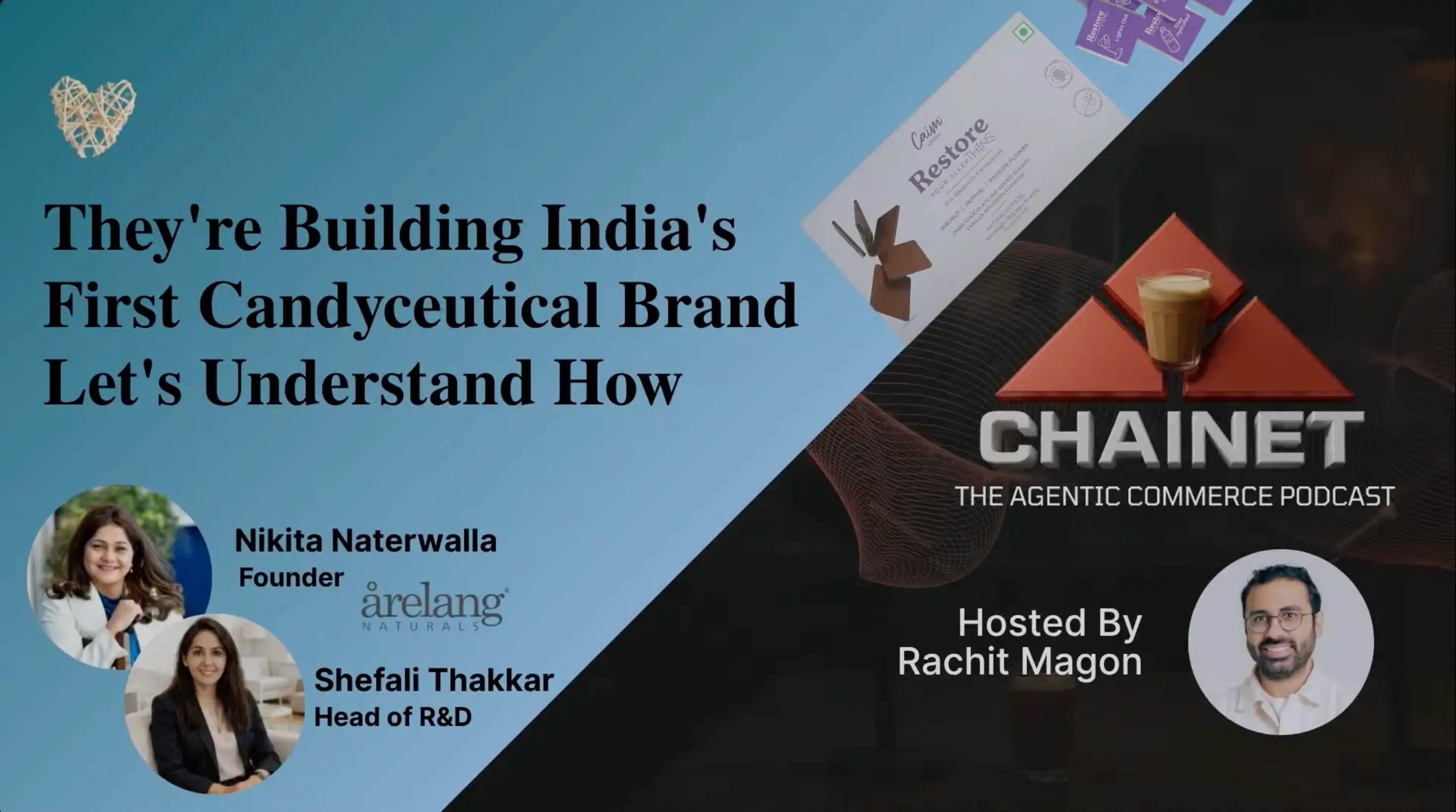
They're Building India's First Candyceutical Brand - Nikita Naterwalla & Dr. Shefali Thakkar, Arelang Naturals
Nikita Naterwalla started Arelang Naturals after her own perimenopause diagnosis left her drowning in supplements that didn't feel like food. Dr. Shefali Thakkar leads the R&D, formulating chocolates and gummies that act like nutraceuticals. They talk about coining the term 'candyceutical', why they refuse to use melatonin, the 1000 kg of walnuts it takes to make their sleep formula work, the 150 patient clinical trial behind their thyroid product, and why AI told them their best formula was 'fairy dust'.

Why Your DTC Brand Needs Community Over Audience
Seena and Reyana, co-founders of SheR HQ, break down why chasing followers is killing brand loyalty. They share the real difference between an audience and a community, why WhatsApp groups fail, and how health and wellness brands can build spaces people actually want to be part of.