Search Episodes
Search for podcast episodes by title, guest, or topic.
She Quit Meesho Right Before Its IPO to Sell Short Kurtas. Here's Why
Sanchita Gupta left a corporate career that took her from HackerEarth to Exotel to Meesho's CTO office to build Mr. Saa, a menswear brand betting that short kurtas can become daily wear, not just festive wear. She talks about the leap, the 75-day content grind, and why marketing a habit is harder than making a good product.
Women have already made the switch. Kurtas and kurtis stopped being festive wear and became something you throw on for a grocery run or a college lecture. Men never got that same shift. Ask an Indian man what belongs to him and daily wear, and the honest answer is a t-shirt and jeans, maybe a polo if he's dressing up. Everything Indian in his wardrobe still lives in the "occasion only" pile.
Sanchita Gupta noticed that gap and decided to fill it, one short kurta at a time.
She spent eight years in the corporate world before that, and none of it was a straight line. An engineering degree she didn't want, an internship she landed in seven days after a fight with her father, two and a half years learning inside sales at Exotel, four years as an executive assistant who was doing everything except calendar management, and a final stop at Meesho working directly with CTO and co-founder Sanjeev Barnwal, right as the company was gearing up for an IPO.
She quit anyway. Papers down in July 2024, last working day in October, and then Mr. Saa, a short kurta brand for men that she's trying to build into a daily habit rather than a wedding-season SKU.
This conversation is about what it actually takes to build that kind of habit change from scratch, as a solo founder, with no playbook and a lot of Instagram reels.
Key Takeaways: Building a Habit, Not Just a Brand
The Career Detour That Wasn't Wasted:
- Sanchita realized two years into engineering that coding wasn't for her, skipped campus placements entirely, and built her non-tech career through a Bangalore internship at HackerEarth in 2017
- Two and a half years in inside sales at Exotel, four years as an executive assistant at Inref doing research and cross-team communication instead of calendar management, then a year at Meesho working with CTO Sanjeev Barnwal
- Every stop added a skill she now uses daily: sales from Exotel, org-level thinking from being an EA, stage confidence from hosting events at Meesho
The Actual Gap in Menswear:
- Brands like Fab India and Sada already sell short kurtas, but Sanchita's read is that it's just one SKU among a hundred for them
- Mr. Saa launched with 100% pure linen short kurtas and is now adding cotton and prints because linen alone limits how wide an audience can afford to buy in
- The goal isn't replacing polos and t-shirts, it's adding a section to the wardrobe that didn't exist before
What Actually Breaks a Solo Founder:
- A 75-day daily content series before launch, followed by a 21-day content break in June after burning out from doing shooting, editing, manufacturing, sourcing, and networking all at once
- A trip to Rishikesh was the reset, not a strategy session
- Building a good product turned out to be the easier part; she credits her family's textile background (a grandfather who ran his own cloth shop, a mother running a boutique since 2005) for making sourcing and quality control second nature
Q: For anyone hearing about Mr. Saa for the first time, who are you and what is Mr. Saa?
Sanchita Gupta: Okay. So I am just another engineer who decided not to take the engineering route, right? Have been working in the corporate world for eight years. Took that leap of faith to decide to create something of my own. Hence Mr. Saa is my first child, right? So Mr. Saa is a menswear brand. It's a short kurta brand for men which we are trying to promote for them to wear on a daily basis.
🔥 ChaiNet's Hot Take: "My first child" is doing a lot of work in that sentence. Founders who talk about their brand like a dependent, not a deliverable, are usually the ones who stick around long enough to make it work.
Q: Give us the journey from engineering to Mr. Saa, what was it like?
Sanchita Gupta: I was very clear since my college days itself that I'm not a coding person. Two years down the lane I realized that coding is not my thing and I need to figure out my career. A lot of seniors in my college told me that since you are very active with respect to fest, you've been into sports, you've been an all-rounder, so you need to do an MBA. I decided okay, I'll give a CAT exam because this is what everyone says, engineering and then MBA. Final year was more of a fun thing for me, I wasn't very serious with respect to studies. Four years done in the college, had nothing in hand. Did not sit for my college placements also, because in an engineering college it's mostly technical companies that are coming for the placements. So again came back home with a perspective that I'll study for my cat. Back home had a fight with my father, he was like give a bank exam, we want you to have a job. I was like I don't want to work right now, I want to study for my cat. Had a fight with him. Applied for an internship in Bangalore, because being an engineer I had this keda, I'll create a tech product, I'll try to solve that solution. So the first step towards that was lead generation for me. So I joined HackerEarth as an intern. Like after the fight with my father, I had seven days to apply, seven days I got an intern and I was in Bangalore, almost fifteen days after my college got over.
🔥 ChaiNet's Hot Take: She went from a father-daughter fight to a job offer in a week. Most people take a week just to draft the resignation letter they never send.
Q: What was HackerEarth like, and how did that first job shape you?
Sanchita Gupta: For coding people, you can get a full-time job, but an engineer with zero experience in the non-tech side, I needed an intern, and HackerEarth became that learning place for me. And that was the time when HackerEarth was growing, everyone was on it, 2017. So I had a tech background and a sales perspective to it and got the perfect mentor over there, Shishir, a guy named Shishir was my manager. He became the mentor for me for my sales journey. He taught me how to do lead generation, how to chase a particular deal, how to get converted into a sales call. From there I joined Exotel, right, Exotel was the place where I got to learn inside sales. So I was creating a step-by-step journey for me in the non-tech sector without an MBA, maybe without realizing that I was doing that, but somehow having good mentors helped me.
🔥 ChaiNet's Hot Take: She built a career ladder without ever naming it a career plan. Sometimes the mentor matters more than the master's degree.
Q: You spent two and a half years at Exotel and then made a big shift into an executive assistant role. How did that happen?
Sanchita Gupta: Inref again I joined as a salesperson, but eight months into the role, my founder called me on a random morning saying, Sanchita would you take the EA role, would you like to work as my executive assistant? I was like, I don't know what to expect out of this role. So he told me, I also don't know what to expect, all I know is that you and I have a good frequency, and since we are at a growth stage I want someone who has the same frequency with me. We both will learn together, and I know that you have this clear thing in your head that you want to create your own company. So you'll get a vision from the top on how the management works, you'll be acting as a bridge between me and the employees. So you'll get that understanding across the organization. I was like, okay, let's take this step.
🔥 ChaiNet's Hot Take: A founder who hands you an undefined role and says "we'll figure it out together" is either handing you a launchpad or a dead end. In her case, it turned out to be the former.
Q: A lot of people think the EA role is just calendar and travel management. What did the job actually look like for you?
Sanchita Gupta: My work was less of his calendar management, more of research, more of understanding, on like a very small example, I was creating the company subsidiary decision, right, whether we should create the subsidiary or keep the company. So I had multiple things to research on. Was helping him across all the meetings, I was there across all the meetings. So it gave me a very good opinion on how the company runs from the top. He gave me a totally different perspective to that, so it was very less of his calendar management, more of me reducing his burden around research, researching around competitors, helping communicate within the employees.
🔥 ChaiNet's Hot Take: The best EA roles are apprenticeships in disguise. She wasn't managing a calendar, she was watching how decisions actually get made at the top, which is a masterclass no MBA program sells.
Q: Then you moved to Meesho and worked with Sanjeev Barnwal, the CTO and co-founder. What did that year give you?
Sanchita Gupta: Meesho was more of a thing that I wanted strongly on my resume, I stayed there for just a year, worked with Sanjeev who's the CTO and co-founder. Meesho did one very good thing with me, because for the past seven years I was working within the team, right, Meesho gave me that platform to be back on the stage, so I used to host over there, I used to organize events over there. So before it was more of the internal, instead this was more of the external, and it gave me that confidence back to be on the stage and to talk to people, because the EA role was more defined towards me working as an individual person.
🔥 ChaiNet's Hot Take: She spent seven years building depth behind the scenes and one year rebuilding her voice on the stage. Turns out you need both before you can pitch your own brand to strangers on Instagram.
Q: Meesho was supposed to go public the next year, and everyone told you that you were making a mistake by leaving. Why did you do it anyway?
Sanchita Gupta: Everyone around me was, you're making a mistake of putting down the papers. But when you work in any organization like Meesho, you work with that energy, right, so you feel like this is the time for you to take this step, get out of your comfort zone and create something of your own. So in October 2024, I did put down my papers. I put down my papers in July, but I had my last working day in October 2024. I sat idle for four, five months. Traveled, took some time, because eight years of working, I wanted time to be free. Did freelance also in between for three, four months because I did not want to go back to a permanent job till then. So sitting idle with the freelance thing, my husband randomly said that you had this idea in your head, so this is how I started working again on Mr. Saa.
🔥 ChaiNet's Hot Take: Walking away right before an IPO sounds reckless until you realize the energy of a growth-stage company is exactly what convinces you to go build your own. She didn't leave despite Meesho, she left because of it.
Q: Where did the idea for Mr. Saa actually come from?
Sanchita Gupta: Saa is something I never had the name to it, but in 2023 December I was researching around it. Do I have a gap in the men's wear market, do I think that I can actually create a brand out of it, but Meesho happened back then, so I kept this idea aside. I took a survey of close to 300, 350 people to understand what is their buying pattern, whether this is actually a market cap or not, whether men's wear is actually growing. In 2025 I started working on that because I had kept it aside, then I realized that the men's market is growing immensely. Suddenly the men's grooming market is growing, men's wear market is growing, and everyone is focusing towards men. That's how I realized okay, this is the right time to be into the men's wear market.
🔥 ChaiNet's Hot Take: She sat on the idea for over a year, ran a 350-person survey, and waited for the market to prove itself before building. That's not indecision, that's diligence most founders skip.
Q: Where do you think the actual gap is that Mr. Saa is trying to fill?
Sanchita Gupta: As a woman we have kurta, kurtis, saris which we've already started wearing on a daily basis. From the t-shirt, jeans, we have already started switching to Indian wear nowadays, not just for festivals but on a daily basis also. As men what do they have? T-shirt, polo shirts, everything is beautiful but nothing belongs to us. And I'm not saying that Indian men don't have anything of their own, they have dhotis, they have bandhgalas, they have long kurtas, but that is something you cannot wear on a daily basis, right, kurta is too long for you to wear on a daily basis. Hence the short kurta, hence Mr. Saa exists. I don't say that I'm the first one to create short kurtas, I respect what Sada and Fab India are doing, they also have short kurtas, but they are creating it as just one another SKU. They're not marketing it as a habit. For them it's just an SKU. It's my entire brand and it is something that belongs to us that we can proudly wear.
🔥 ChaiNet's Hot Take: Everyone else is selling a product. She's selling a category. That's a much harder pitch and a much bigger prize if it works.
Q: Do you think Indian men are actually ready for that psychological shift, from polos to short kurtas?
Sanchita Gupta: I'm not asking them to leave the polos. I'm asking them to create an additional section in the wardrobe for the short kurtas. I can ask you to start wearing your culture on a daily basis, not on all the seven days of the week maybe. For a few people when they've already started wearing it on a daily basis, they started enjoying it. For a few people when I still reach out to them, they say we're still looking for the occasion to wear this short kurta, so that will take time. But we have already started seeing that change, because across the world everyone is looking at what India is doing, Indian music, Indian food, Indian clothes. If you look back ten years, wearing a sari was a difficult thing for a lot of women, and people weren't that much in favor of it because we came with that mentality that a housewife has to wear it. Nowadays that shift has already come for women. For men it is a slow process, but the market is growing in that direction. It has become a habit for me, whenever I'm in a crowd nowadays I keep observing who is wearing a short kurta, which brand are they wearing, how comfortable are they in it.
🔥 ChaiNet's Hot Take: She's not tracking sales numbers as her leading indicator, she's tracking strangers at malls. When your metric for product-market fit is "did I spot it in the wild," you know you're building a culture shift, not just a catalog.
Q: You mentioned you once posted content for 75 days straight and then took a 21-day break because it burnt you out. What happened there?
Sanchita Gupta: I've been creating content since last November. Before the launch I had created this 75-day series in which I was actually thinking, creating, shooting, editing, and posting for the whole 75 days, and it was the brand journey on how we were creating the brand. One positive thing that did to me was I had a hard stop, that I have to launch the brand on the 5th of February, there is no way I can skip that timeline because I've already created that hype. In June, I realized while writing a caption that I'm doing the same thing again and again. Maybe I need to take a pause, take a break, because I am a solo founder over here, I'm managing the content, the networking, the manufacturing, the prints, and when a lot of things are going in your head, there comes a saturation at particular times. So that is why I decided to take a break.
🔥 ChaiNet's Hot Take: A hard launch deadline forced her to create for 75 straight days. A caption she couldn't write anymore forced her to stop. Both were the same instinct, listening to when the work was actually working.
Q: How did you spend that break, and what did it change for you?
Sanchita Gupta: As a solo founder you always have this guilt of not even being there for a day, and for the past almost a year it was never that I had a mental break, my mind was always working wherever I was traveling. When I quit Meesho I went to Rishikesh, was there just for two, three days, but it is a place which actually helps my mind shut. So I wanted my mind to shut for a few days, and I guess Ganga Maiya has that energy to bring that change for you. I went to Rishikesh, was there for just two, three days, but it did that magic to me, that it's okay to pause, it's okay to take a break, it's okay to not create random content but think about it and then create. I've had that loss of not having a conversation with a few people for fourteen, fifteen days, of not posting, of not telling what's happening with respect to the brand, but that was much cheaper.
🔥 ChaiNet's Hot Take: Fifteen days of silence felt expensive in the moment and cheap in hindsight. Most solo founders never test that trade because the guilt gets there first.
Q: What has been the hardest part of this whole journey so far?
Sanchita Gupta: I guess the whole journey is the hardest thing, the journey is still going on, so I don't know whether what I'm saying today as the hardest will be the hardest for me tomorrow or not. Sourcing and finalizing the cloth were a bit easier for me because I come from a family background of clothes, my nanaji had his own kapde ki dukan, my mother has her own boutique which she has been running since 2005. I was very clear that with respect to quality we'll be giving the quality because I have the experts at home. I did my research part over here in Chickpet, they did the research part in Jaipur, we had two fabrics, we asked people around us which fabric they liked more, it was the Jaipur fabric which won the competition. Currently creating a good product is easier than marketizing it. Instagram looks beautiful from outside, it gives me views, it is giving me virality, but to get that business out of that virality is something that's the most difficult thing for me. Sometimes I look back and I see, why am I creating this content if this is not giving me business right now. A lot of people come and say it's a long game, and I also know that I'm playing a long game, so it will take time.
🔥 ChaiNet's Hot Take: Growing up around a family cloth shop and a boutique meant sourcing was never the hard part. Turning views into buyers is the part no family business could have prepared her for.
Q: How does selling in person, at pop-ups, compare to selling online?
Sanchita Gupta: Pop-ups are more easier than doing it online honestly, because in the pop-ups I have that salesperson coming out of me, I can go and sell it in person over there, it's easier for me to showcase the product because it's the quality which we are selling alongside the habit change. So when they get to see the fabric, when they get to feel it, it's a different conversation.
🔥 ChaiNet's Hot Take: Her sales training from Exotel comes alive in a room, not on a grid. Some skills don't translate to a screen, they just wait for the right room to walk into.
Q: If someone hearing your story right now is thinking about starting their own thing, what would you tell them?
Sanchita Gupta: If you have this in your mind that you want to experiment, at least at some point of your time, don't have a lot of thoughts around it, take that leap of faith. You'll figure it out on the way. There is nothing that is impossible to be done. Things take time, you'll have your own challenges, no one can prepare you for those challenges, they can share their learnings, but you'll have your own set of learnings, your own challenges. Don't be scared of them. It's okay to fail. All you'll do is you learn a lot from that journey. If you are someone who's waiting and rethinking around whether I should quit my job or not, whether I should actually go into the market or not, if I fail, it's okay to fail. It's okay to experiment and you'll be successful. Things will take time, but yes, you'll do good. Have to start and then have to hang in there for the longest.
🔥 ChaiNet's Hot Take: Start and hang in there. Two verbs, no framework, no five-step plan. Sometimes the most useful advice is the one that refuses to be turned into a slide.
Final Thoughts: The Product Was Never the Hard Part
Sanchita's closing perspective: "Have to start and then have to hang in there for the longest, right?"
The bottom line: Sanchita's story is really two founding stories stacked on top of each other. The first is a career that looked scattered from the outside, engineering to sales to executive assistant to Meesho, but was quietly building exactly the toolkit she'd need later: sales instinct from Exotel, systems thinking from being an EA, and stage presence from Meesho. The second is Mr. Saa itself, where the hard part was never the product. A founder with a family background in textiles was always going to get sourcing and quality right.
What she's still fighting is the much harder problem: convincing Indian men that a short kurta belongs in their daily rotation, not just their wedding-season wardrobe. That's not a supply chain problem, it's a culture problem, and culture problems don't move on a founder's timeline. They move on their own.
Her answer to that mismatch was to burn herself out chasing a 75-day content deadline, then have the self-awareness to stop for three weeks in Rishikesh when it stopped working. For a solo founder juggling manufacturing, sourcing, content, and sales alone, that kind of course correction is as much a skill as any of the ones she picked up in eight years of corporate life.
Q: How can people connect with you and learn more about Mr. Saa?
Sanchita Gupta: You can check us out at mrsa.in or on our Instagram, that's where I share the brand journey and the products.
Final words: The women's wardrobe shifted from occasion wear to daily wear over a generation, not overnight. Sanchita is betting the men's wardrobe can do the same, one short kurta and one Instagram reel at a time. If her story says anything, it's that the leap of faith is the easy part. The hanging in there, through a 75-day content sprint, a burnout, and a market that hasn't fully made up its mind yet, is where the real work happens.
Related Shorts
Explore short-form videos that expand on the ideas covered in this blog.
Similar Episodes

13 Years at Amazon, Two Layoffs, and a T-Shirt That Survives 50 Washes: The NUITO Story
Vivek Sivaraman spent 13 years building his career at Amazon before two back-to-back layoffs in 2024 pushed him to start NUITO, a fashion brand built on fabrics most people in India have never worn. He talks about why he picked the one thing he was worst at, how NUITO sources long-staple cotton from a fragmented Indian supply chain, and what it takes to prove a T-shirt can survive 50 washes.

Manya Nayar Built IBEAUTY Because No One Was Making Makeup For Men
Manya Nayar, founder of IBEAUTY, on spotting the gap in gender-neutral makeup, why she spent three years researching before launching her first product, and what it actually takes to build a luxury beauty brand in India.
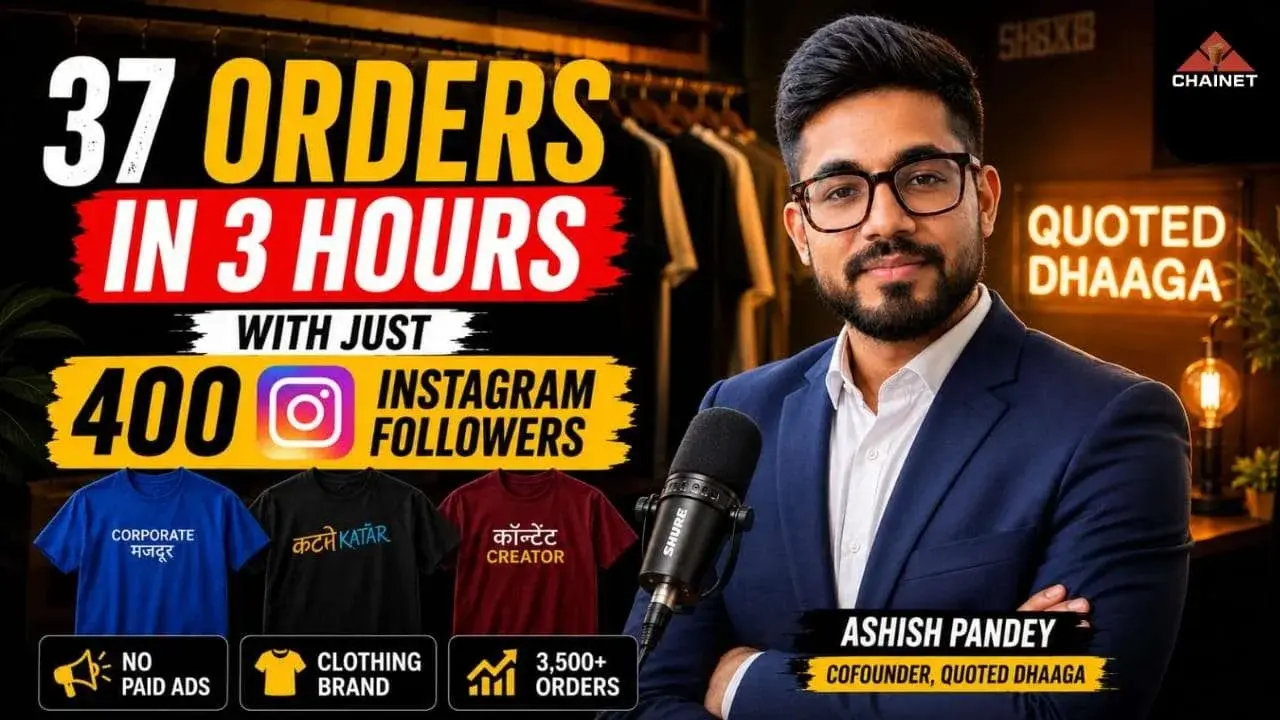
How Two Childhood Friends Built Quoted Dhaaga Into a Bootstrapped Clothing Brand Without Spending a Rupee on Ads
Ashish Pandey, co-founder of Quoted Dhaaga, opens up about starting a relatable clothing brand with his childhood best friend, selling 4,000 pieces with zero ad spend, and the chaotic Delhi vendor story that almost derailed launch day.

Perfumes for the Weather, Not Just the Occasion: Inside éclat Maison's First Year
Shantanu Kasana, founder of éclat Maison, talks about spotting a gap in India's fragrance market while studying in London, and building a perfume brand around one simple idea: your scent should match the weather. In under a year, the brand has crossed 10,000 bottles sold and is growing 30 to 50% month on month.