Search Episodes
Search for podcast episodes by title, guest, or topic.
Three Root Canals, Two Implants, and a Toothpaste Brand: Ankit Agarwal's Fang Story
Ankit Agarwal, co-founder of Fang Oral Care, on why oral care has stayed stagnant for decades, what nano-hydroxyapatite actually does to your enamel, and why he thinks toothpaste is about to have its skincare moment.
Most of us brush our teeth twice a day and never once check what's actually in the tube. We'll read the back of a shampoo bottle, obsess over our skincare ingredient list, and interrogate what's in our protein powder. But toothpaste? That's autopilot. Squeeze, brush, spit, forget.
Ankit Agarwal wants to break that habit. He's the co-founder of Fang Oral Care, a clean label oral care brand now backed by Honasa Consumer, the parent company of Mamaearth. His origin story isn't a typical founder pitch about spotting a market gap in a spreadsheet. It's three root canals, two implants, and a slow-dawning realization that the product sitting in his bathroom every single day was full of ingredients he wouldn't tolerate anywhere else.
Ankit isn't new to building brands either. Before Fang, he built MyNutraKart, one of the early D2C players in India, back when D2C wasn't even a term anyone used yet. He shut it down, and he'll tell you exactly why, without dressing it up.
This conversation gets into what nano-hydroxyapatite actually is, why legacy oral care brands never touched it, whether AI can build a moat for a D2C brand, and why Ankit thinks oral care is about to go through the same transformation skincare went through a decade ago.
Key Takeaways: What It Takes to Disrupt a Category Nobody Questions
The Origin Story:
- The idea for Fang was conceptualized in 2021 after Ankit started reading ingredient labels obsessively and realized his own toothpaste contained things he wouldn't otherwise use.
- It took 16 to 18 months of formulation and paperwork before the product actually launched in 2022.
- Fang uses nano-hydroxyapatite at a 5% concentration, a level Ankit says most competing NHA-based brands in India don't match.
Lessons From a Second-Time Founder:
- MyNutraKart taught Ankit that distribution is not the same thing as a brand. Good numbers without an identity meant no loyalty when acquisition costs spiked.
- His pharma manufacturing background makes him harder to fool by manufacturers, but also slower to launch because he insists on formulation certainty first.
- Fang deliberately runs with just three SKUs so far, prioritizing depth over breadth.
Where AI Actually Fits in a D2C Brand:
- AI is currently used most heavily in customer intelligence (parsing reviews, tickets, comments) and content production.
- Ankit's take: AI can generate content, but it can't generate conviction. The real moat left for D2C brands is a defensible point of view, not speed.
- Operations and smarter inventory decisions are the next frontier Fang is building toward.
Q: Your story starts with three root canals, two implants, and a question. When did the question actually arrive?
Ankit Agarwal: So honestly, the dental work was the wakeup call but the shift happened when I started reading the ingredients on the labels for everything that I eat or put on my skin. And then I looked at my toothpaste and I realized that it contains ingredients that I wouldn't otherwise use or put in the products. That's when it stopped being personal. If I, someone paying attention like me, had missed this for years or for decades, I'm sure so had millions of others. So that's where we thought that oral care is waiting for disruption and there's a lot of space for an oral care brand which is science-backed.
🔥 ChaiNet's Hot Take: The best consumer brands rarely start with market research. They start with someone reading a label they should have read years ago.
Q: What year did this actually start, and when did you take it live?
Ankit Agarwal: The idea was conceptualized in 2021 and we actually took this live in 2022. So we took our own time. We took a good 16 to 18 months to get the product right, to get all the paperwork in place, all of that.
🔥 ChaiNet's Hot Take: Eighteen months of getting the formulation right before shipping anything is a very unfashionable way to build a D2C brand in 2022. It's also probably why the product still holds up.
Q: You're a second-time founder. Before this, you built MyNutraKart. What did that teach you, and why did you shut it down?
Ankit Agarwal: We were one of the early birds in D2C. In fact, when we started MyNutraKart, D2C was not even a buzzword. There were no VCs, there was no funding, nothing. But what MyNutraKart taught me was that distribution is not the same as a brand. We had great products, good numbers, however, we had no identity the consumer could rally around, and when things got hard, there was no loyalty to fall back on. So with Fang, the fan conviction comes first and that's completely non-negotiable. Also, I think shutting something down is underrated. It builds your instinct for when to stop optimizing a losing game. So when the customer acquisition cost for MyNutraKart was haywire, we realized that it's time to take a step back.
🔥 ChaiNet's Hot Take: Distribution gets you customers. Brand gets you customers who come back when the ads stop working. Most founders learn the difference the hard way, exactly once.
Q: Let's get into the product. There's a mention of nano-hydroxyapatite. What is it, and what's your bet around it?
Ankit Agarwal: I think clean label should not be a packaging decision but a formulation philosophy. And with Fang, one of the hero active ingredients that we use in our toothpaste is called nano-hydroxyapatite. Your enamel is made of hydroxyapatite, but when it gets damaged through acid, abrasion, whatever, it can't regenerate on its own. Nano-hydroxyapatite fills those micro-gaps, it's biomimetic, meaning it's literally the same mineral your teeth is made of. It has been used in Japan for decades, and while the only alternative is fluoride, fluoride works by hardening the enamel, whereas hydroxyapatite works from within by remineralizing enamel. So it's a better long-term bet and the science backs it. I'm not sure why so many legacy brands didn't use this in their formulations. I think they were more price-conscious and more distribution-led, and that's where the opportunity for modern oral care brands like ours exists.
🔥 ChaiNet's Hot Take: Fluoride hardens what's there. Hydroxyapatite rebuilds what's missing. That's the difference between defense and repair, and most toothpaste on your shelf has only ever offered you defense.
Q: Are you worried the big legacy brands might swoop in once you've done all the education?
Ankit Agarwal: I always feel, if there are more people entering the category, it means the category is expanding and growing. And if a big brand enters the space, they also spend more on educating the consumers and creating awareness. So that's never something I think as founders we worry about. You have to stick to your narrative, to your story, you have your core, you have your consumer to cater to, so we just focus on that.
🔥 ChaiNet's Hot Take: It would be hard for a Maruti to suddenly sell a Mercedes. Brand positioning isn't just marketing, it's what kind of consumer already trusts you, and that trust doesn't transfer overnight.
Q: How do you want Fang to be positioned in people's minds?
Ankit Agarwal: For us it's very clear. We want to be the Apple, we want to be the Dyson of oral care. So we want to be the premium play in this space, something which is clinical but cool and modern. That's how we are positioned.
🔥 ChaiNet's Hot Take: "Clinical but cool" is a harder needle to thread than either word alone. Most brands pick one and call it a day.
Q: When someone buys toothpaste, what should they actually be checking on the label?
Ankit Agarwal: Definitely not salt. A lot of brands say salt, so I think that's a bit gimmicky and quite meaningless if you ask me. I'll make your question into two parts. Clean formulation, with today's advent of AI and the kind of awareness consumers have, is non-negotiable. When I say clean label, it means no triclosans, no parabens, no harmful preservatives, no artificial sweeteners, all of that. That's something which should be taken for granted by consumers today. The other part is what active ingredient does your toothpaste contain and what is the concentration of that active ingredient. There are other brands selling a nano-hydroxyapatite based toothpaste in India, but we're probably the only ones using a pure 5% concentration. A small percentage of an active ingredient is really meaningless. It's more of a label claim, it's not doing any good for your enamel.
🔥 ChaiNet's Hot Take: A label claim and an effective dose are not the same thing. Read the percentage, not just the buzzword.
Q: You come from pharma manufacturing and exports, not marketing or tech. What did pharma teach you about building a D2C brand?
Ankit Agarwal: I come from a third-generation pharmaceutical background. I started my career working at my father's personal care manufacturing company, manufacturing toothpaste for other brands. So I understand supply chain. While most D2C founders obsess over brand and acquisition, which of course matter, the unit economics of a brand are built in manufacturing and logistics. Pharma taught me to respect formulation integrity, batch consistency, and what it actually costs to not cut corners. A lot of brands look clean on the outside and are messy on the inside.
🔥 ChaiNet's Hot Take: Brand is what the customer sees. Manufacturing is what determines whether the brand survives contact with reality.
Q: Does that pharma background give you an unfair advantage, or does it just make you more cautious than you need to be?
Ankit Agarwal: Both honestly. The advantage is I can't be fooled by a manufacturer's pitch. I know what a good process looks like. And the disadvantage is of course sometimes I'm slow to launch because I want formulation certainty. In D2C, speed matters, so I've learned to balance that instinct with getting to market. But I'd rather launch the right product than launch fast and fix later, especially a product that goes into people's mouth. I think it's more of an advantage than a disadvantage. One mantra is important to me: be an inch wide and a mile deep, rather than a mile wide and an inch deep. It's very easy today to launch products and put them out there. Fang only has three SKUs right now in the toothpaste category. We want to understand, get customer feedback, optimize and then launch more.
🔥 ChaiNet's Hot Take: Move fast and break things doesn't work when the thing you might break is someone's enamel.
Q: Who is buying Fang today, and what's surprised you about that consumer?
Ankit Agarwal: The early adopter is exactly who you'd expect: urban, label-conscious, age 25 to 40, already switched to clean skincare, same for oral care. What surprised me is the gender split. We assumed it would skew heavily female, as it does in skincare, but we have a strong male cohort, men who care about their health seriously but didn't have a brand that spoke to them in oral care. So Fang resonates there.
🔥 ChaiNet's Hot Take: Assumptions carried over from adjacent categories are still assumptions. The market will correct you the moment you actually launch.
Q: Do most Indian consumers still not look at what's inside their toothpaste? Do they just care about price and mouth feel?
Ankit Agarwal: Agree for the majority today. Disagree as a permanent truth. That's exactly what they said about skincare maybe a decade ago, and then brands like Mamaearth, Minimalist, Plum, they all proved that when you educate and make it accessible, the consumer moves. The difference is oral care had no credible challenger in the past decade or more and there was also less education or awareness around it. That's the gap we are filling. I think what skincare was maybe a decade ago, oral care will own the next decade in the personal care category.
🔥 ChaiNet's Hot Take: Every "consumers don't care" category is really just a "nobody's tried hard enough to educate them" category in disguise.
Q: Is your strategy education first, or branding first?
Ankit Agarwal: I would say it's a mix of both. It is a bit of education as well and it is branding as well. That's when I keep saying you have to be clinical but cool. First has to be the science. A toothpaste is not something you want to flaunt to your friends, no matter how much you would love to call this a lifestyle brand. It's something which sits on your bathroom shelf. The primary objective when buying a toothpaste is the benefit it gives you. The education business is when you tell the consumer why he needs to switch from his existing toothpaste to a more science-led, modern brand. And of course, branding establishes a lot of credibility, it gives the consumer that experience. You have to find the balance between good education and branding both.
🔥 ChaiNet's Hot Take: Nobody posts their toothpaste on Instagram. If your brand strategy depends on flaunt value, you've picked the wrong category.
Q: Where does AI sit inside Fang today? Content, operations, product, customer support?
Ankit Agarwal: Primarily in content and customer intelligence for now, understanding what the consumers are saying, reviews, tickets, comments, at a level of detail we couldn't process manually. On the content side, we use it to move faster. A brand of our size can punch above our weight in content output because of AI. Operations I would say is next, we are building towards smarter inventory and logistics decisions. And, both your name and my name have AI in it, so AI is integral to the future for every founder and for every brand.
🔥 ChaiNet's Hot Take: AI's first job at most D2C brands isn't building anything flashy, it's reading the reviews nobody had time to read before.
Q: If AI makes content, data, and customer journeys accessible to everyone, what becomes the real moat for a D2C brand in the next two to three years?
Ankit Agarwal: It's a very interesting question. We've always been very data-driven, right from the days of MyNutraKart, all our decisions were based on data, and that should be the genesis for any brand. I think while AI can generate content, it can't generate conviction. A brand with a clear defensible belief system will always cut through because the output reflects that clarity. A brand that uses AI to say the same thing as every other brand just faster will drown in the sameness. The moat is you actually stand for something, something the customer can trust and remember.
🔥 ChaiNet's Hot Take: AI removes the excuse of not having output. It does nothing for the problem of not having a point of view.
Q: You're now backed by Honasa Consumer. How did that conversation start, and what were they trying to understand?
Ankit Agarwal: I think the conversation started as an outreach on LinkedIn from their team. We weren't looking to really raise funds if I can be honest. But when we met Varun, spoke to the team, the kind of clarity of thought he had, you definitely want someone like him and someone like Honasa on your team. I think they were also looking at the oral care space and they didn't have too many options of brands which have not already raised or are not funded. They saw we were doing good numbers, scaling fast, a good team, a hungry young team, three co-founders each with almost 20 years of experience, cumulatively about 60 years of experience. I think all of this together, the chemistry and the founder alignment, everything got aligned and that's how they came on board.
🔥 ChaiNet's Hot Take: The best fundraising story is the one where the founder wasn't fundraising. Conviction gets noticed before a pitch deck ever does.
Q: For other D2C founders who won't get a LinkedIn outreach from a strategic like Honasa, what should their game plan actually be?
Ankit Agarwal: I think for any D2C brand, their game plan should not be to raise funds. Their single-point agenda should be to listen to the consumer, build a credible brand, learn early. Raising early is not the right way to do it in my opinion. Sometimes you're spending the money you raised too early on pushing products that don't have product-market fit. It's important as founders that you learn first, listen to your consumer, be humble, stay grounded, and once you realize you're onto something big, you have consumer love. Brian Chesky, the founder of Airbnb, said find 10,000 consumers who love you, then find the next 1,000 who find you. Suddenly you know you have a million consumers who love you and use your product. You need to go step by step. Just getting funded and thinking you're going to go all out and get a million consumers straight away, I don't think that's the right strategy.
🔥 ChaiNet's Hot Take: Ten thousand people who love you will do more for a brand's survival than a hundred thousand who merely tried it once.
Q: Five years from now, if Fang wins, what changes?
Ankit Agarwal: I think the number one would be that oral care becomes a considered purchase, not something your mother goes and buys and you use every morning without thinking. People start reading labels. Dentists start recommending our products by leading, not just by brand. Hopefully Fang is a name that would lead that shift in India. Globally, the ambition is to be in conversation along with brands that have come out of Europe and Asia and are defining modern oral care. For that to happen, product integrity and distribution have to scale together, and that's the work we've cut out for ourselves.
🔥 ChaiNet's Hot Take: The real win for any category creator isn't market share. It's when the old way of buying starts to feel a little embarrassing.
Final Thoughts: Oral Care's Overdue Skincare Moment
Ankit's closing perspective: "Investing in a good science-backed toothpaste is an SIP that you make in your oral health."
The bottom line: Ankit's journey from three root canals to co-founding Fang is really a story about noticing what everyone else has stopped questioning. Toothpaste is one of the last personal care categories to escape real scrutiny, and Fang's bet is that the same wave that hit skincare a decade ago, driven by ingredient literacy and clean label demand, is about to hit oral care next.
What makes his approach different isn't just the science, it's the discipline behind it. A pharma manufacturing background that makes him distrustful of shortcuts. A second failed venture that taught him distribution without brand identity doesn't survive hard times. And a deliberate refusal to scale SKUs faster than the formulation can be trusted.
For other founders, the takeaway isn't really about toothpaste at all. It's about resisting the urge to raise early, chase scale before conviction, or let AI's speed substitute for an actual point of view. Build the 10,000 people who love you first. The rest, as Ankit points out, tends to follow.
Q: How can people connect with you and try Fang?
Ankit Agarwal: Well, they can find us on our website, it's fangoral.com. They can also look us up on Amazon. We are now on Blinkit, Instamart, and soon going to be on Zepto as well, so all the quick commerce platforms. I would strongly tell people to please try our products and share your feedback with us. Let us know what you think. I've put all my 20 years of experience into this. I started again because I thought this category requires a brand like Fang to be there with a science-backed product.
Final words: Oral care has been on autopilot for decades, and it took someone willing to shut down his first company, read every label on his bathroom shelf, and sit through three root canals to notice. If this episode made you look at your own toothpaste a little differently, that's the whole point. Start reading the label. The next decade of personal care might just be sitting in the small tube you use twice a day.
Related Shorts
Explore short-form videos that expand on the ideas covered in this blog.
Similar Episodes
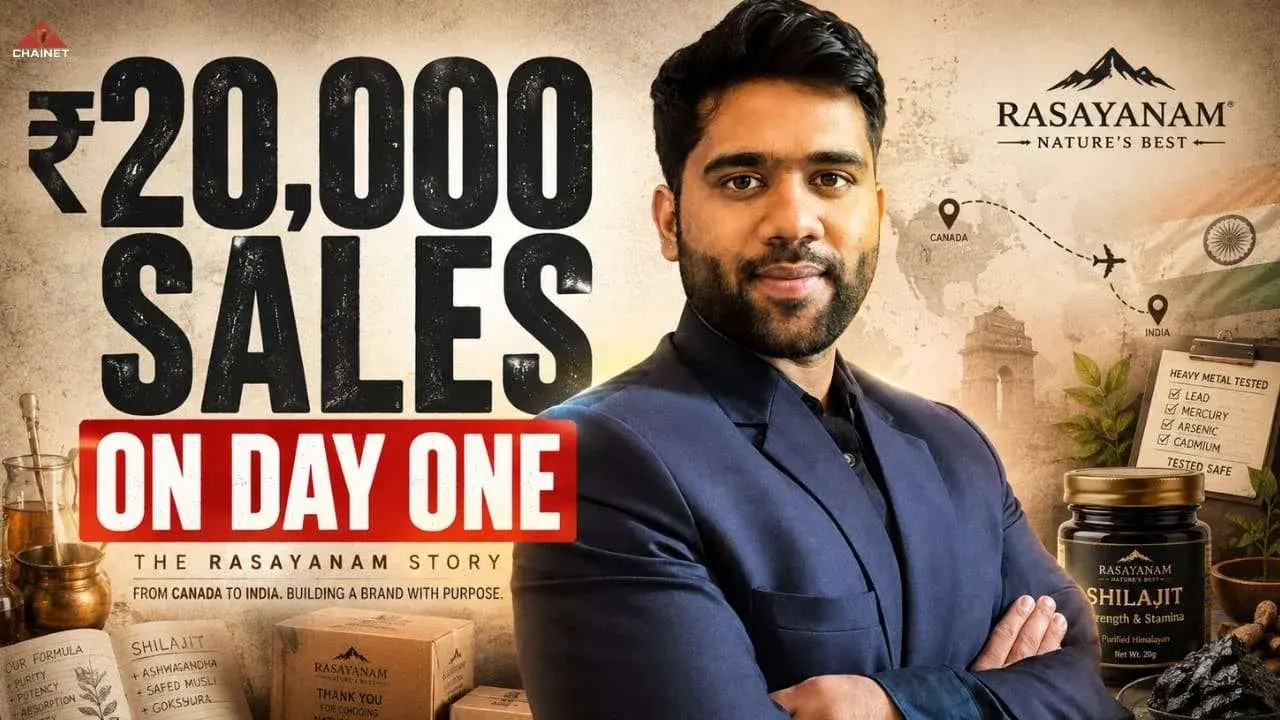
He Left a Stable Life in Canada to Sell Shilajit in His Basement. Now Rasayanam Does 20 Lakh Customers Without a Rupee of Funding
Ayush Agarwal, founder and CEO of Rasayanam, walked away from a stable career and life in Canada to build a science-backed neutraceutical brand from scratch in India. He talks about launching Shilajit from his basement, staying bootstrapped for five and a half years, and why he pivoted from an Ayurvedic identity to a broader neutraceutical one.
Can India's Oldest Medicine Win India's Newest Market? - Sargam Dhawan Bhayana, Planet Herbs
Sargam Dhawan Bhayana studied filmmaking in New York, came back to Dehradun, and joined her grandfather's 20-year-old Ayurvedic manufacturing business. After eight years inside the factory, she's pivoting Planet Herbs from a B2B contract manufacturer to a consumer-facing D2C brand, while also launching The Botanical Theory in skincare. She talks about earning credibility from a 30-year-veteran workforce, why being invisible makes you replaceable, the brutal five-level vetting process to stay listed on quick commerce, and what it takes to optimize for AI discovery in 2026.
Hair Loss Has a Stigma. He's Trying to Change That - Kailash Nichani, Topee
Kailash Nichani spent 20 years building businesses, including a stint at Swiggy and a failed run at Glassic. He started Topee in January 2024 after watching the hair patch industry overcharge, oversell and obscure its product quality. He talks about why he ditched his e-commerce thesis after 100% of customers pushed back, why he hasn't rushed to scale beyond one studio in two and a half years, the pricing opacity that lets some studios sell a 35,000 rupee patch for a lakh, and why he calls Topee an anti-2026 business.
You Don't Need 20 Supplements, You Just Need the Right One - Akshita Singla, Aakya Wellness
Akshita Singla grew up around a pharmaceutical family and watched the Indian supplement industry boom into chaos. She walked away from a career in Luxembourg to build Aakya Wellness, a clean label nutraceutical brand sitting at the intersection of Ayurveda and modern bioactives. She talks about why most Indian supplement brands are marketing first and product second, the truth about no-sugar labels and stevia versus monk fruit, why she ran 70 to 80 iterations on a single collagen flavor, and how she actually uses AI to formulate.