Search Episodes
Search for podcast episodes by title, guest, or topic.
Can Heritage Fragrance Become the New Luxury Obsession? - Astha Suri, Naso Profumi
Astha Suri is the founder and creative director of Naso Profumi, India's first green perfumery, built from Lucknow. She studied interior architecture in Bristol, fashion styling in Milan, and came back home to do what her family said was impossible. Naso is vegan, gender neutral, Ayurvedic and completely bootstrapped, and Vogue India named their tobacco the best fragrance of the year. She talks about what green perfumery actually means, why she calls true luxury the moment you stop chasing it, the unexpected channels that worked and the ones that did not, and why fragrance is one of the few categories AI cannot fully crack.
Fragrance lives in almost every Indian home. You've smelled it at weddings. You've smelled it in your grandmother's room. Maybe in a small shop in an old city, sitting next to the agarbatti and the ittar bottle. But you've probably never thought of it as luxury. You just thought of it as something familiar.
Today's guest looked at the same familiarity and saw something completely different. Astha Suri is the founder and creative director of Naso Profumi, India's first green perfumery. She studied interior architecture in Bristol. She studied fashion styling in Milan. And then she came back to Lucknow, of all places, to build a luxury fragrance house her own family said was impossible to pull off out of India.
Naso is vegan. Gender neutral. Ayurvedic. Completely bootstrapped. Vogue India named their tobacco the best fragrance of the year. The brand started in a city most luxury investors wouldn't put on a map, and is now showing up in airports, hotels, and detail-led luxury retail in India and abroad.
This conversation is a Lucknow story. A family story. A story about what Indian luxury actually means when you stop chasing the European playbook and start engineering the rituals you grew up with. It's about the discipline of building slowly, the contradiction of being heritage-rich and globally curious at the same time, and what happens when one of the most sensory categories on earth meets a generation of consumers who buy through algorithms.
Key Takeaways: What Green Perfumery From Lucknow Looks Like
The Brand Bet:
- Naso Profumi is positioned as India's first green perfumery, deriving its philosophy from green design, ergonomics and ecological systems carried over from architecture and design school
- Vegan, gender neutral and Ayurvedic, with Vogue India naming the tobacco fragrance the best of the year
- Built and creatively directed out of Lucknow, completely bootstrapped, with a deliberate refusal to follow the standard Bombay or Delhi luxury playbook
The Indian Luxury Reframe:
- Most Indian consumers don't see Indian fragrance as luxury. Convincing them to spend 5,000 to 10,000 rupees on an Indian-made perfume is the category's biggest hurdle
- True luxury, in Astha's words, is the moment you stop chasing it. Indian luxury wins when it is deeply Indian first and globally appealing second, not the other way around
- The sustainability story is not a marketing layer. It's the small 20% additions, water harvesting, closed-loop processes, reusing what already exists, that turn an old craft into a green one
The Channel and AI Reality:
- Channels were a mixed bag. Some that should have worked at scale didn't, while detail-led luxury retail, hotels and airports surprised on the upside
- Mass market fashion-style channels were tested and pulled because the unit economics didn't make sense for a luxury fragrance line
- AI helps with research, structure and operations, but fragrance is one of the few categories where the purchase is sensory and emotional. AI cannot fully replace the storytelling, the bottle, or the moment a customer relates to the founder
Q: You came back from Bristol and Milan to build a luxury fragrance house in Lucknow. Why Lucknow?
Astha: Lucknow is home. It's the city where the rituals around fragrance are built into daily life. Coming back wasn't a sacrifice. It was a choice to build close to the source.
Bombay and Delhi run on a different speed. They reward visibility. Lucknow rewards depth. For a fragrance house that wants to be taken seriously globally, building slowly out of a city like Lucknow has actually been a feature, not a bug. The pace of the city forces patience into the product.
ChaiNet's Hot Take: Most Indian luxury still gets built in Bombay because the founders are scared of distance from the buyer. Astha did the opposite. The brand's geography became its identity. The next decade of Indian luxury will be defined by founders who realised tier-1 metro pace is not the same as tier-1 craft.
Q: For our viewers, what does "green perfumery" actually mean?
Astha: By green, what we mean is we derive green design and everything we've known as architects, engineers, designers in school. Eco-friendly design patterns, ecological systems, ergonomics. How things can be better for the environment, designed and thoughtfully manufactured to also cater to that audience and bring in that difference in the product stream so people around us can also think like that.
Green perfumery bridges from green design. We've tried to notice how environment is a key aggregate in everything we make.
ChaiNet's Hot Take: Green is not a label you stick on a bottle. It's a discipline that runs from raw material to packaging to the studio it's mixed in. Most "clean" beauty brands borrowed the word from skincare. Naso took it from architecture school, and it shows on the back of the pack.
Q: How is green perfumery different from "Ayurvedic" perfumery? Are they the same thing?
Astha: They overlap, but they are not the same. Ayurvedic refers to the ingredients and the heritage of the formulation. Green refers to the design and the system around it. You can have an Ayurvedic perfume that isn't green. You can have a green perfume that isn't Ayurvedic. We try to be both. Naso uses Ayurvedic and natural ingredients, and the entire process is engineered to be ecologically sound.
It's the kind of thing nobody has done in fragrance in India because nobody's looked at the whole picture. It was all very chemical, and now suddenly it's green. Nobody added the last 20%. Water harvesting, closed-loop reuse, where the wash water actually goes. Add those small things, complete the cycle, and you're sustainable in real terms, not just in terms used in a brand deck.
ChaiNet's Hot Take: Sustainability in Indian D2C has become a sticker. The brands that actually do it are the ones counting their own water, packaging, and waste. The 20% nobody else does is exactly where the moat lives.
Q: There's a strong Indian instinct for circular use. Old t-shirts become dusting cloths. Old containers become storage. Is that part of the Naso DNA?
Astha: Of course it is. It's how most of us were raised. Nothing was thrown out. Even an old t-shirt from 10 years ago becomes a dusting cloth. Glass jars get reused. We tried max-and-max it inside Naso too. Operationally that means less new packaging, more refill thinking, more reuse of what we already have. Those Indian roots are what we are still learning to put back into modern brand design.
ChaiNet's Hot Take: Indian sustainability didn't start in 2020 with carbon footprints. It started with grandmothers. The most credible green brands in India will be the ones who simply industrialize what every Indian household already does for free.
Q: The Indian market doesn't see Indian perfume as luxury. How do you make them respect a 5,000 or 10,000 rupee Indian perfume?
Astha: That is the hardest question in this category. The Indian consumer's default reference for luxury is European. A Tom Ford. A Creed. Anything bottled in Paris or Florence. Indian fragrance has been priced at attar shop levels for so long that the luxury price tag feels like a stretch.
The way you change that is not by competing with Europe on their terms. It's by being so deeply Indian that the consumer realizes the bottle they're buying could not have been made anywhere else. The composition, the heritage, the rituals, the story behind every note. Once you are unmistakably Indian, the price stops being a question. It becomes the cost of owning something the rest of the world is going to want.
You don't get to true luxury by chasing it. You get there when you stop chasing it.
ChaiNet's Hot Take: The day Indian luxury stops trying to look French is the day it starts winning. Every great Italian or Japanese luxury house won because it doubled down on local craft, not because it imitated Paris. Astha's framing is the cleanest articulation of where Indian luxury has to go next.
Q: A community question. Should Indian luxury look more global or more deeply Indian?
Astha: Be true to who you are first. Have a global appeal as the outcome, not as the strategy. Deep Indian roots, global craftsmanship, global storytelling. That's the order. Brands that try to look global before they look Indian end up looking like nothing. Brands that go deeply Indian first often end up traveling further than the global-first ones ever did.
ChaiNet's Hot Take: Identity scales further than imitation. The next Indian luxury brand to hit a billion in revenue will be the one that didn't soften its accent. Heritage is a global passport if you don't dilute it.
Q: When did fragrance actually enter the picture for you? You weren't a perfumer by training.
Astha: I trained in interior architecture in Bristol and fashion styling in Milan. I always thought I'd be in design or fashion. Fragrance entered in the way most powerful ideas do. Slowly, through everyday life, through smell memories from home, through the way a city like Lucknow communicates through scent. Once I realised nobody was building a green Indian perfumery from the ground up, the gap was obvious. I just couldn't unsee it.
I was 23 when I started. If you have that drive at that age and you're a viewer of this listening, just go for it. Don't think so much. You can.
ChaiNet's Hot Take: The best founders don't pivot into a category. The category pivots into them. Astha didn't decide to build a perfumery. She kept noticing what was missing, and the brand became inevitable. Founders who wait for permission to switch fields almost never start.
Q: You're bootstrapped. What does that actually buy you in luxury?
Astha: Time. Bootstrapping forces you to build slowly, which is the only way to build a luxury brand. You can't shortcut the craft. You can't shortcut the customer. A funded brand has 24 months of pressure to scale. A bootstrapped brand has the luxury of building for the next decade.
For a category like fragrance, where the product takes time to develop and the brand takes longer to land, that patience is the most expensive resource you can have. We've kept Naso lean on purpose.
ChaiNet's Hot Take: Bootstrapping in luxury is not a financial constraint. It's a creative one. The pace it forces is the same pace the product needs. Funded luxury brands often die from the speed of their own capital.
Q: Naso has sold through your website, through detail-led luxury retail, at airports, at hotels, internationally. Was there a channel you assumed would work that didn't?
Astha: There was. We tested a couple of mass-market style channels because, on paper, the volume and reach looked obvious. The reality was very different. Walk-in volumes were strong but the conversion economics didn't make sense for a luxury fragrance. The customer profile was wrong, and the spend per visit didn't justify the cost of being there. We pulled back.
What surprised us on the upside was detail-led luxury retail, hotels, and airports. Customers in those moments are pre-disposed to discovery. They have time. They're already in a "treat yourself" mindset. The unit economics worked beautifully there.
ChaiNet's Hot Take: Channel-market fit is the most under-talked-about D2C metric in luxury. The same customer with the same income behaves entirely differently at a mall versus an airport. Founders who confuse footfall with intent burn cash for years. The right shelf is the one where the customer is already in a buying state of mind.
Q: For Naso to go global, what has to happen first?
Astha: Indian fragrance has to be respected at home before it can travel. The biggest hurdle is not export. It's domestic credibility. Once Indian luxury consumers stop apologizing for buying Indian perfumery and start choosing it because they prefer it, the global story almost writes itself.
Beyond that, the operational layer is real. Regulatory approvals, country-by-country compliance, raw material certifications, distribution. We're doing the groundwork now. The brand is already in the hands of people in different parts of the world through travel and gifting. Formal global expansion is a question of when, not if.
ChaiNet's Hot Take: Indian luxury exports always start with the diaspora and the well-traveled local consumer. They carry the brand into the world before any retail deal does. The smartest founders treat domestic luxury credibility as the launchpad, not as a stepping stone to skip past.
Q: Have you seen Indian luxury brands successfully go global, and what surprised you about that?
Astha: Yes, and the surprising part is it's still rare. Indian luxury brands that have gone global tend to be in fashion, jewellery, or hospitality. Fragrance is genuinely new territory for India. There isn't a clear playbook yet. We're building a lot of the answers as we go.
That's exciting and unexpected. It also means there's no shortcut to copy. Every step is a first step.
ChaiNet's Hot Take: Being early in a category nobody has cracked is the loneliest place to build. It's also the place that lets you write the rules nobody else gets to follow. India's first green perfumery globally is going to be defined by Naso, not against an existing benchmark.
Q: Looking back at your first two years, was there a mistake you still haven't forgotten?
Astha: Honestly, all of them. I was 23. I assumed people would take the brand seriously because the product was strong. They didn't. I had to learn that being a young female founder in luxury, in Lucknow, comes with the cost of having to prove yourself twice. I made mistakes around hiring, around channel choices, around how aggressively to spend. None of those were fatal, but each of them slowed us down by months.
You make mistakes when you start. It's natural. As long as you're not making the same mistake twice, you're growing.
ChaiNet's Hot Take: Every founder in luxury has to absorb the discount the market applies to them in year one. Young, regional, female, bootstrapped. Each one is a quiet tax. The founders who survive year two are the ones who stop apologizing and start showing the work.
Q: Is AI useful inside Naso today, or is it noise?
Astha: Both. Useful for research, content structuring, claims clarity, and operational tasks like scanning supplier documentation. It compresses time. We've tried it for everything from brand copy drafts to regulatory mapping for international markets.
It's noise the moment you let it touch the soul of the product. Fragrance is sensory and emotional. A perfume is not just the scent. It's the bottle. The brand. The person who created it. The moment in your day when you reach for it. AI doesn't get any of that. It can search faster than I can read, but it cannot stand at a counter and watch a customer fall in love with a note.
ChaiNet's Hot Take: AI is the world's best research analyst. It's also the world's worst storyteller. The founders who win in fragrance, fashion and luxury more broadly will use AI to compress the boring 80% so they can spend even more time on the irreplaceable 20%.
Q: Will AI ever really pick the right perfume for someone?
Astha: I don't think so. Not the way people are imagining it. Perfume is identity, mood, memory. It's tied to the bottle on the dresser, the founder's story, the way a particular note reminds you of a place. Even if AI gets very good at matching a scent profile to a personality, it cannot replace the storytelling that makes someone choose one perfume over another.
A perfume is also nostalgic. People remember the green Brut bottle from their fathers' shelves and can still smell it just by imagining the bottle. That association is human. That's not something an algorithm can manufacture.
ChaiNet's Hot Take: Some categories are AI-resistant by design. Fragrance lives at the intersection of memory and identity. The day an algorithm replicates that, the entire human experience of taste collapses. Until then, fragrance founders have one of the most defensible moats in retail.
Final Thoughts: When Indian Luxury Stops Apologizing
Astha's reframe: "You get to true luxury when you stop chasing it. Be deeply Indian first. The global appeal follows."
The bottom line: Astha is building the brand most Indian founders are still afraid to try. Luxury, fragrance, bootstrapped, regional, gender neutral, vegan, Ayurvedic, all at once. Every layer of that positioning is a conversation that has to be won with a different audience. Family. Customers. International press. Domestic retail. The fact that Vogue India crowned the tobacco the best fragrance of the year is not the validation. It's the receipt.
For founders building in luxury, the playbook is uncomfortable. Build slowly. Stay bootstrapped longer than you think you should. Pick channels that match your customer's state of mind, not your ambition. Optimize for credibility before scale. And stop trying to look global before you look Indian. The global story writes itself once the local story is undeniable.
For consumers, the next time you reach for a 5,000 rupee Indian perfume and feel a tug of doubt, ask yourself why that doubt didn't show up when you bought a 5,000 rupee French one. The bias is the bottleneck. The brand doing something about it just happens to be in Lucknow.
Q: How can people connect with you and learn more about Naso Profumi?
Astha: You can find Naso on our website and through select luxury retail in India. We also ship internationally on request. Follow Naso on Instagram for new launches and the story behind each fragrance, and reach out to me directly on LinkedIn if you want to talk about building Indian luxury, fragrance, or bootstrapping a creative business. We're always looking to meet founders, retailers and customers who want to be part of building this category from India outwards.
Final words: Indian luxury is not a smaller version of European luxury. It is its own thing, built on its own rituals, scented with its own ingredients, designed with the discipline of a country that has been making things by hand longer than most of the brands consumers reach for today. Astha is one of the few founders willing to build at that pace, in that geography, with that conviction. Naso isn't trying to be the next French house. It's trying to be the first Indian one. That distinction is the entire point.
Similar Episodes
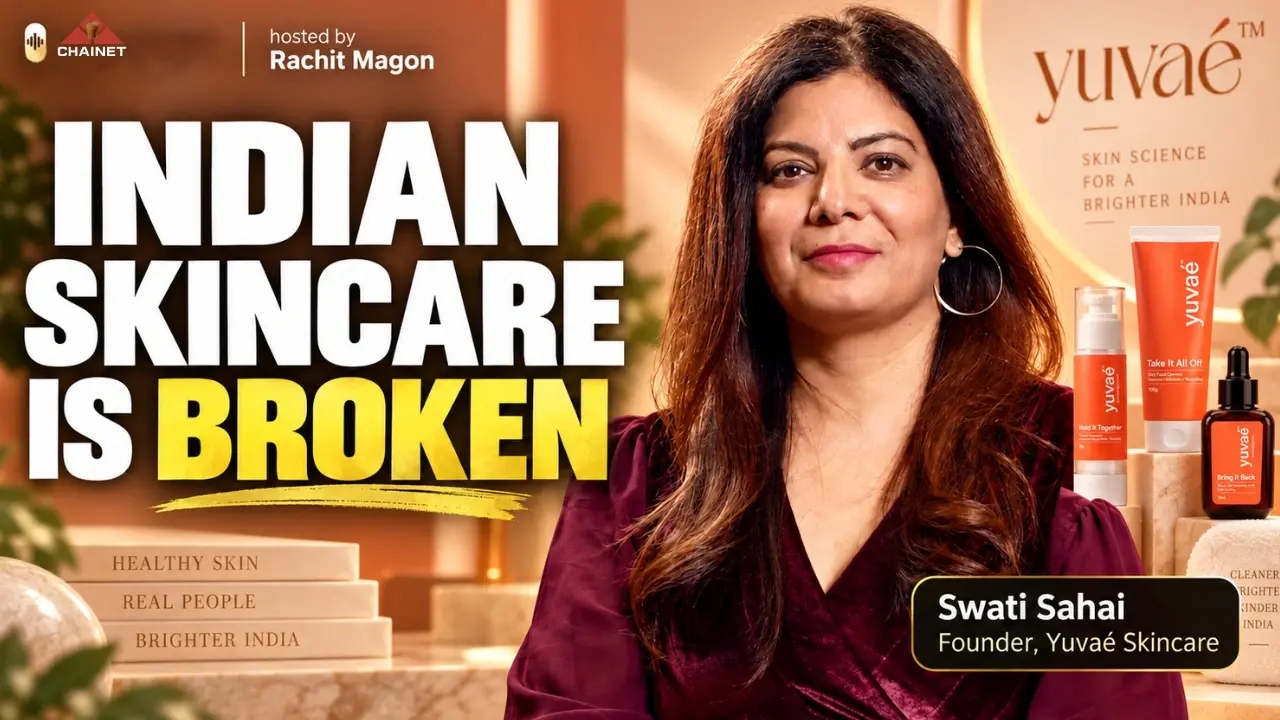
From SAP Dashboards to Serums: How Swati Sahai Built Yuvaé After Two Decades in Enterprise Tech
Swati Sahai spent two decades leading SAS customer analytics teams across Boston, Mumbai, and Asia Pacific before scrapping a finished production batch ten days before launch. Here's how that decision, and a formula that blends ectoin with amla and moringa, became Yuvaé.

How a 9-to-5 Employee Is Building a Kundan Jewelry Brand One Weekend at a Time
Mahima Daga, founder of Rajshaan, talks about building a handcrafted kundan and fusion jewelry brand alongside a full-time tech sales job. From a Diwali conversation with her dad to her first sale at a stranger's wedding, this is a story about starting messy and staying consistent.

Can India's Oldest Medicine Win India's Newest Market? - Sargam Dhawan Bhayana, Planet Herbs
Sargam Dhawan Bhayana studied filmmaking in New York, came back to Dehradun, and joined her grandfather's 20-year-old Ayurvedic manufacturing business. After eight years inside the factory, she's pivoting Planet Herbs from a B2B contract manufacturer to a consumer-facing D2C brand, while also launching The Botanical Theory in skincare. She talks about earning credibility from a 30-year-veteran workforce, why being invisible makes you replaceable, the brutal five-level vetting process to stay listed on quick commerce, and what it takes to optimize for AI discovery in 2026.

You Don't Need 20 Supplements, You Just Need the Right One - Akshita Singla, Aakya Wellness
Akshita Singla grew up around a pharmaceutical family and watched the Indian supplement industry boom into chaos. She walked away from a career in Luxembourg to build Aakya Wellness, a clean label nutraceutical brand sitting at the intersection of Ayurveda and modern bioactives. She talks about why most Indian supplement brands are marketing first and product second, the truth about no-sugar labels and stevia versus monk fruit, why she ran 70 to 80 iterations on a single collagen flavor, and how she actually uses AI to formulate.