Search Episodes
Search for podcast episodes by title, guest, or topic.
She Watched a Little Girl Struggle, Then Built the Device No One Else Would - Dr. Kanan Doshi, The Able Company
Dr. Kanan Doshi spent 32 years as a pediatric occupational therapist before co-founding The Able Company with Neera, the mother of a child with arthrogryphosis. Together they built Hands On, a patented mechanical adaptive device with seven attachments that lets people with physical limitations feed themselves, comb their hair, brush their teeth and write. She talks about why she kept the device deliberately battery-free for rural India, the two and a half years of prototyping that turned a screw mechanism into magnets, and getting incubated by IIT Madras almost by accident.
For 32 years, Dr. Kanan Doshi sat across from children who could not do things every other child took for granted. Holding a spoon. Brushing their teeth. Combing their hair. She'd recommend solutions, suggest devices, send parents to scour the market. At some point, she stopped recommending and started building.
Dr. Kanan is the co-founder of The Able Company, an IIT Madras incubated startup that makes Hands On, a patented adaptive hand device for people with physical limitations. It doesn't need a battery. It doesn't need an app. It doesn't need any training. Just a simple mechanical handle with seven attachments that lets someone feed themselves, comb their hair, brush their teeth, write, paint, and even use a tablet.
The story didn't start in a lab. It started when Kanan met a 19 day old baby girl named Mira's daughter, born with arthrogryphosis, a rare congenital disorder where the joints don't move properly. As Mira's daughter grew up, the family searched everywhere for products that could help her be independent. Spoons that didn't work. Combs that didn't fit. Imported devices that cost a fortune and still didn't solve the problem.
Mira, an architect and product designer, started sketching. Kanan, the senior pediatric occupational therapist, started giving inputs. Two and a half years of prototyping later, they had Hands On. They've built it for the 19 day old babies, for the mothers of those babies, and for a country where assistive technology has never had a serious commercial home.
This conversation is about what it actually takes to bring a hardware device for the disabled to market in India in 2026, why it's deliberately mechanical, and what 32 years of therapy practice looks like when it finally walks out of the clinic and into the world.
Key Takeaways: Building an Assistive Device Indians Could Actually Use
The Device:
- Hands On is a single ergonomic handle with seven interchangeable attachments for spoon, fork, comb, toothbrush, pen, paint brush and stylus
- A "Plexicord" extension lets users with limited bending range still use the attachments
- The whole thing is mechanical. No battery, no app, no training, no app updates
The R&D Reality:
- The first prototype was in May 2021. The final product took another two and a half years and around 20 prototypes
- The original screw-in attachment was scrapped because patients with limited grip couldn't fasten it. They moved to magnetic attachments
- Even the strap loops were redesigned so a person with mild grip could put the device on themselves without help
The Distribution Bet:
- The Able Company sells through NGOs, foundations, doctors and therapists rather than direct-to-consumer
- Faith and clinical recommendation are the two things that actually get people with disability to try a new device
- The deliberately low-tech, no-battery design lets the device reach rural India where electronics break and replacement parts disappear
Q: For 32 years you've been a pediatric occupational therapist. What does that actually mean?
Kanan: Occupational therapy is about making a person independent despite their disability. Whatever the disability, however severe, our job is to help that person do their daily life on their own. With adults we call it rehabilitation. With children we call it habilitation, because we're teaching them to be independent for the first time.
I started 32 years ago when I joined Madhya Children's Hospital. From day one I knew I wanted to work only with kids. The day a parent walks into therapy, they're usually still in shock. Their child has been diagnosed with something life-changing and they're in the depression phase. Acceptance hasn't come yet. As a therapist you're not just working with the child. You're working with the parent. You help them see positivity in what they're dealing with so the child can actually move forward.
The acceptance phase is the most important phase. Once it comes, both lives become easier and the child does very well.
ChaiNet's Hot Take: The biggest unlock in pediatric therapy is not a new device or a new technique. It's the moment a parent moves from grief to acceptance. The Able Company's product is essentially packaged hope. It's giving acceptance a tool to point at.
Q: Was there a time when you couldn't help a child because the right device just didn't exist?
Kanan: Many times. I'd think, if only I had something. The whole world of assistive technology has only really started developing in India in the last 10 to 15 years. Before that, very little was made in India and what existed was mostly DIY. You'd adapt a spoon, you'd adapt buttons. Nothing extensive. Most of the time the child was completely dependent on the parent or caregiver for eating, combing, dressing.
I look at some of the products being made today and I wish they existed for those kids 15 years ago. They could have done so much more. That's the gap we're trying to fill. Hands On wouldn't exist if I hadn't seen that absence over and over again.
ChaiNet's Hot Take: Most product founders solve a pain they encountered. Kanan is solving a pain she watched 32 years of patients encounter. That's a different category of empathy. It's the kind that makes you patient enough to take 20 prototypes to get the screw mechanism replaced with magnets.
Q: Tell us how Hands On actually works.
Kanan: It's a simple ergonomic handle. You wear it on your hand, your hand is supported, and you attach an accessory. You can switch out the spoon, the fork, the comb, the toothbrush, the pen. There's also an extension we call the Plexicord. If your hand can't bend enough to reach your face or your plate, you attach the Plexicord and then attach the accessory. So even users with very limited mobility can comb their hair or feed themselves.
There are seven attachments today. We deliberately designed it as one handle with many attachments instead of seven separate devices. Earlier in the market you had to buy a separate spoon, a separate comb, a separate brush. Ten products for ten activities. That's too complicated for anyone, especially a person managing a disability. One handle. Many lives.
ChaiNet's Hot Take: The most expensive thing in assistive tech isn't the device. It's the friction of switching between five different devices to do five different daily tasks. The Able Company's real innovation is the platform, not the attachments. One handle. Seven jobs.
Q: What did the first prototype look like and what changed?
Kanan: May 2021 we got our first prototype in our hand. The handle looked similar to today, but the attachment mechanism was completely different. It was a screw-in. You'd screw the spoon into the handle. We tested it on a few patients and realized something obvious. If your hands don't work properly, you can't screw anything in. You need someone to do it for you. So you're still dependent on a caregiver to switch attachments, which defeats the entire purpose.
So we went back. We changed the screw to a magnetic attachment. We changed the strap. We redesigned the loops so even a mild grip could pull them on. Then we added the Plexicord. From the first prototype to the final product, around 20 iterations and another two and a half years of work.
You can't ship a hardware device the way you ship software. In tech you build for a month and push it out. In healthcare, you can't do that. Every iteration has to be tested with real patients. Every change has to actually help the user be more independent, not less.
ChaiNet's Hot Take: Hardware for the disabled cannot be tested in the founder's apartment. It has to be tested by the people whose grip strength was the original problem. The screw-to-magnet shift is the kind of insight you only get by putting prototype four into the hand of a patient who can't twist anything.
Q: How did you end up incubated at IIT Madras?
Kanan: Honestly, I'd say it was luck. We presented our prototypes at an occupational therapy conference. Someone there mentioned that IIT Madras has a program called Empowered that focuses on assistive tech. We did a bit of research, set up a stall there, and Dr. Ashok Junjurnemala, who heads the research, walked past our stall. We asked him to take a look. He looked at it, said this is amazing, and offered to incubate us.
We didn't apply through any formal process. The hard work was building enough of a working device that someone like Dr. Ashok could see it and recognize what it was. Once you have something real to show, doors open. Without that prototype I'd have nothing to put in front of him.
ChaiNet's Hot Take: Founders romanticize incubators as gatekeepers. The truth is most incubators are looking for builders who already shipped something. Kanan and Mira didn't pitch a deck at IIT Madras. They put a prototype on a table. The prototype was the application.
Q: Why is the device deliberately mechanical? No battery, no electronics?
Kanan: Both of us wanted to reach the grassroots. Rural India. Interior areas. If the device runs on batteries or any kind of tech, it becomes much harder to take it to a village. Where do you charge it? What happens when the battery dies? Where do you find a replacement? It's a completely mechanical device, no batteries, anyone can use it anywhere.
We also realized that the same device can be used as a home rehab tool. Someone with one weak hand who isn't getting therapy in their village can wear Hands On and do daily activities to get the hand exercised. 15 minutes of meeting work, or just combing your hair every day. The device doubles as a low-cost home rehabilitation tool. That's not just an adaptive device, that's a rural rehab strategy.
ChaiNet's Hot Take: The fastest way to ruin an assistive device for Bharat is to make it electronic. Hands On is mechanical not because the founders couldn't add a chip, but because they explicitly chose not to. The product roadmap reads like a quiet rebellion against tech-first design.
Q: Who is Hands On actually for? Beyond children with disabilities.
Kanan: It started for children. That's where Mira's daughter and most of my therapy practice came from. But once we started using the device, we realized the same product helps adults with mild to moderate Parkinson's. They need a bit of training but it works. Anyone with limited hand function, post-stroke patients, elderly users, even people recovering from injuries.
The lens we use is simple. If you can wear the device, you can use it. The disability doesn't have to be congenital. The age doesn't matter. If your hand can't hold a spoon today, Hands On can hold it for you while you do the rest.
ChaiNet's Hot Take: A device built for children with arthrogryphosis ends up helping Parkinson's patients in their 60s. The most useful assistive products are accidentally cross-generational. The Able Company is selling to therapists and parents today. In five years, it's selling to elder care.
Q: What channel has worked best for you?
Kanan: What we found is that families don't trust assistive devices easily. Parents have already spent money on medical treatment, on therapy, on caregivers. They've been disappointed before. They're hesitant. To get them to try a new device, the recommendation has to come from someone they already trust.
So our best channel has been NGOs, foundations, dermat-equivalent doctors, occupational therapists and physiotherapists. When a foundation that works with people with disability tells a family that this device will help, that small factor of faith is what gets them to try it. Going B2C alone is much slower because the awareness gap is too big. The trust has to be borrowed first.
ChaiNet's Hot Take: In healthcare you don't market to the patient first. You market to the trusted intermediary, then let the patient inherit the trust. The Able Company's GTM is borrowed credibility. NGOs, foundations and therapists are the real distribution channel. Direct-to-consumer is the cherry on top.
Q: You've worn the therapist hat for 32 years. Now you wear the founder hat too. How different does that feel?
Kanan: I think I've merged the two. I love being a therapist. It's been part of my life. As a founder, when I get out of the four walls of my clinic and see how many lives we're touching, that feels different. My role isn't confined to my clinic anymore. It's much wider. I've probably merged both hats into one.
Therapy was always one patient at a time. Hands On is hundreds, then thousands of patients at a time. The same intent, just a much bigger frame.
ChaiNet's Hot Take: Healthcare founders aren't a different species from clinicians. They're clinicians who scaled. Kanan didn't stop being a therapist when she became a founder. She just gave her therapy a much larger surface area.
Q: What's the biggest risk to The Able Company in the next few years?
Kanan: Awareness. We want to reach a level where if someone has an accident and they know they can no longer use their hands, the immediate thought is Hands On, the way wheelchair is the immediate thought when someone can't walk. That's where we want to be. We're at the lower end of that ladder right now. Building category awareness is the real work for the next few years.
ChaiNet's Hot Take: The founder isn't worried about competition or funding. She's worried about category creation. That's the most underrated risk in healthtech. Wheelchair has 200 years of awareness baked in. Hands On is starting from zero.
Q: You said the word "disability" doesn't need changing. Why?
Kanan: All of us have some kind of disability. Some are visible, some are not. It's okay to be disabled. The word doesn't need a fancy euphemism. What needs to change is how we treat the people behind the word. Replacing the word with a softer one doesn't help them. Building tools they can use does.
ChaiNet's Hot Take: The world spends a lot of time renaming things and very little time changing them. Kanan's view is the harder, more honest one. Don't sugarcoat the word. Build the device.
Q: What's the one thing every parent of a child with a disability needs to hear?
Kanan: It's possible.
ChaiNet's Hot Take: Two words. They land harder than any clinical brochure ever will. Most parents in their first year after diagnosis only need to hear those two words. The rest of the journey starts there.
Q: When a child who uses Hands On grows up, what do you want them to say?
Kanan: I want them to say that not just me, but The Able Company gave me the faith to be independent. That faith gave me the confidence to be what I am today. That's the long game.
ChaiNet's Hot Take: Founders measure outcomes in revenue. Therapists measure outcomes in confidence. The Able Company is closing both at the same time. The kid who uses Hands On to write his first essay is the kid who eventually writes the testimonial that scales the company.
Final Thoughts: Therapy Walked Out of the Clinic
Kanan's framing: "Everything is possible."
The bottom line: Most healthcare founders come from tech and try to learn medicine. Kanan came from medicine and learned tech. The result is a device that has therapist-grade empathy and engineer-grade simplicity. Twenty prototypes. Two and a half years. Magnets instead of screws. Mechanical instead of electronic. The decisions look small individually. Together they add up to a product that can actually reach a kid in a village.
For founders building in deep tech, social impact or healthcare, The Able Company's playbook is worth studying. The product wasn't designed in a boardroom. It was designed in a therapy clinic, sketched by a mother of an affected child, validated by a 32 year veteran, and stress-tested by 20 cycles of real patient feedback. There are no shortcuts in this category. There's also no defensible competition for a product built this way.
For everyone watching the disability tech space in India, Kanan and Mira's story is a reminder that the most patient founders in the country aren't VCs counting unicorns. They're therapists who've sat across from the same problem for 32 years and finally decided the system wasn't going to fix itself.
Q: How can people connect with you and learn more about The Able Company?
Kanan: You can find us on our website, theablecompany.co. We're working with NGOs, foundations, hospitals and therapists across the country. If you know a child, a parent or a therapist who could use Hands On, please send them our way. We'd love to hear from anyone working in this space.
Final words: The Able Company didn't wait for the assistive tech market in India to mature. It built the device the market should have built 15 years ago. If you've ever watched someone you love struggle to do something the rest of us take for granted, you understand why this matters. The next great Indian healthtech company won't come out of a hackathon. It'll come out of a clinic. Hands On is the proof.
Similar Episodes

From SAP Dashboards to Serums: How Swati Sahai Built Yuvaé After Two Decades in Enterprise Tech
Swati Sahai spent two decades leading SAS customer analytics teams across Boston, Mumbai, and Asia Pacific before scrapping a finished production batch ten days before launch. Here's how that decision, and a formula that blends ectoin with amla and moringa, became Yuvaé.
How a 9-to-5 Employee Is Building a Kundan Jewelry Brand One Weekend at a Time
Mahima Daga, founder of Rajshaan, talks about building a handcrafted kundan and fusion jewelry brand alongside a full-time tech sales job. From a Diwali conversation with her dad to her first sale at a stranger's wedding, this is a story about starting messy and staying consistent.
She Built a Movement Around a Taboo, Then Walked Away From It
Kathy Walkling, Co-Founder of Eco Femme, spent 15 years building India's first washable cloth pad brand from a forest in Auroville into a business reaching women in 27 countries. This is the story of that journey, and the harder story of why she chose to hand it over and walk away.
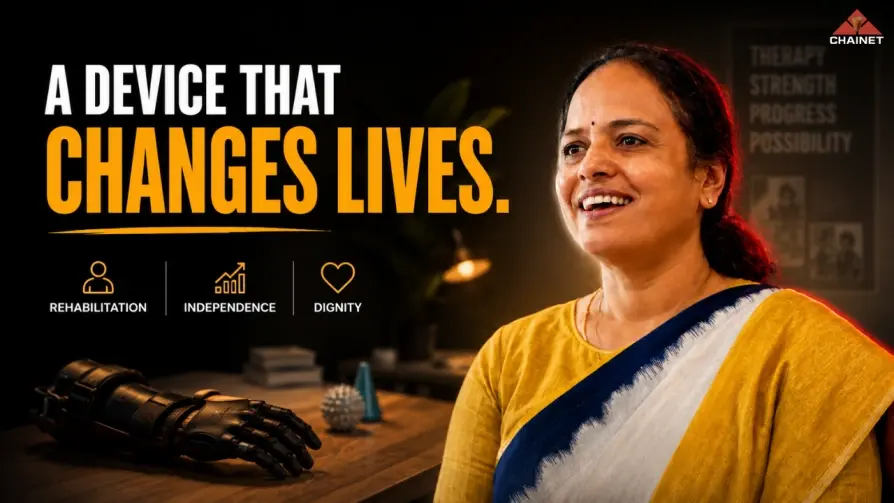
From Therapy Room to Startup: How Dr. Kanan Doshi Is Rebuilding Independence, One Hand at a Time
Dr. Kanan Doshi spent 32 years as a pediatric occupational therapist before co-founding The Able Company. She talks about building Hands-On, a patented battery-free adaptive hand device incubated by IIT Madras, and why awareness, not tech, is the real hurdle in India's disability sector.